
Disciplined by history, adaptive by strategy, steadfast in defense of the nation
The Indian Military is one of the oldest surviving military traditions in the world, shaped by centuries of warfare, strategy, and discipline. From ancient times, Indian armies protected kingdoms, trade routes, and people, using well-planned formations, strong leadership, and deep knowledge of terrain. Over time, this legacy adapted to new realities, absorbing influences from different eras while holding on to core values such as duty, courage, and service to the nation.
In the modern era, the Indian Military has grown into a professional and highly organized force, responsible for protecting the country’s borders and maintaining internal stability. It operates across land, sea, and air, supported by advanced technology and rigorous training. Beyond war, it also plays a key role in disaster relief, peacekeeping, and humanitarian missions. In simple terms, the Indian Military represents strength with responsibility, an institution that balances power with discipline, and tradition with progress.
Foundations of Ancient Indian Military Thought
Ancient Indian military thought was inherently systemic: strategy was not a separate domain, but rather embedded within governance, the economy, and diplomatic practice. Texts such as the Arthashastra articulated structured approaches to intelligence gathering, negotiation, battlefield disposition, and resource mobilization. Commanders were expected to understand terrain, logistics, and psychological factors long before formal military science emerged elsewhere.
The army’s composition in early periods reflected strategic priorities. Infantry, cavalry, chariots, and war elephants were deployed not randomly but according to predefined tactical doctrines. This reflected an appreciation for combined arms effects, where coordination across units generated greater operational leverage. Defensive depth, ambush tactics, and ramparts were prioritized over frontal aggression. Equally significant was the integration of moral and ethical frameworks into strategy. Warfare was to be justified, proportionate, and constrained by norms that protected noncombatants and minimized resource drain. These dimensions underscored a broader strategic philosophy: preserve state stability while avoiding protracted conflict unless necessary.
Strategic Shifts During the Medieval Period
The medieval era introduced heightened complexity in Indian military strategy due to the rise of large polities and sustained interstate competition. Fortifications became focal points of defense planning, and strategic mobility increased with the more extensive use of mounted forces. Armies adapted to siegecraft, reconnaissance operations, and the management of supply chains across extended theatres. Technological infusion, such as early firearms and improved metallurgy, required tactical recalibration. Forces that once relied on shock formations and static defenses increasingly incorporated flexibility, dispersion, and rapid maneuver. While the strategic emphasis on territorial integrity remained consistent, execution became more dynamic, reflecting a layered response to both internal fragmentation and external incursions.
Colonial Rule and Military Reorientation
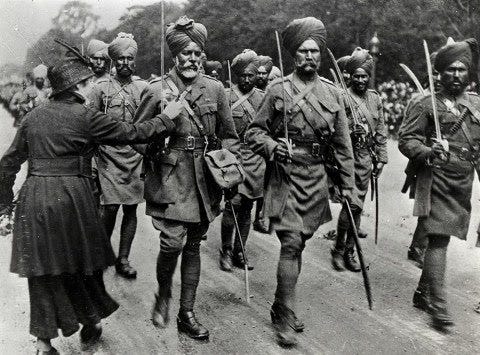
Colonial administration fundamentally altered the architecture of Indian military strategy by subordinating local defense systems to imperial objectives. European command structures, standardization of drill, and hierarchical discipline were implemented across regiments composed of Indian personnel. This professionalization enhanced organizational efficiency but narrowed strategic autonomy.
Simultaneously, indigenous strategic traditions were marginalized, and military force was primarily used for internal control and external projection of colonial power. The result was a dual legacy: (a) modern logistical, training, and administrative frameworks were established, and (b) strategic thought became externally directed, with limited relevance to autonomous national defense.
Post-Independence Strategic Reorientation
The post-1947 period was a turning point in which India reclaimed strategic agency. Faced with immediate territorial conflicts, the nascent state undertook rapid structural reforms to align military capabilities with national defense imperatives. Initial engagements exposed gaps in readiness, interoperability, and doctrinal clarity, prompting iterative learning and capability restructuring.
Civilian oversight was reinforced as a fundamental strategic principle, ensuring that military planning remained aligned with constitutional governance and policy priorities. Institutional mechanisms for joint planning, threat assessment, and conflict management were developed to enhance holistic responsiveness. Lessons from early wars underscored the need for calibrated force posture and strategic deterrence rather than unchecked escalation.
Over time, this phase matured into a stable strategic culture that balanced sovereign defense needs with diplomatic engagement and regional stability imperatives. Emphasis shifted toward sustained preparedness, professional education, and incremental modernization in line with evolving threat matrices.
Modern Indian Military Strategy
In the contemporary context, Indian military strategy operates across multi-domain environments, land, air, maritime, space, and cyber. Strategic planning prioritizes threat anticipation, strategic deterrence, and rapid response capabilities over large conventional offensives. Integration across service branches and cross-domain awareness are central to operational effectiveness, supported by advanced command, control, communications, and intelligence systems.
Nuclear doctrine and calibrated deterrence frameworks have been institutionalized to manage escalation risks. Emphasis on credible minimum deterrence reflects a calculated posture that preserves strategic stability while signaling resilience. Parallel investment in technology, including unmanned systems, networked sensors, and secure communication architecture, indicates a forward-leaning adaptation to modern battle environments.
Strategic partnerships and joint exercises with global partners further strengthen capability interfaces, knowledge exchange, and interoperability. These external linkages complement indigenous defense industrialization efforts, ensuring that strategic autonomy is reinforced without reducing deterrent credibility.
Continuity of Core Strategic Principles
Across epochs, several strategic constants recur: defense prioritized over aggression, strategic patience balanced with calibrated force, and integration of diplomatic and military instruments. Geographic considerations, from the Himalayas to maritime frontiers, have consistently shaped force posture and contingency planning. Intelligence and situational awareness remain core to operational decision cycles irrespective of era or technology. Institutional learning has allowed strategic principles to evolve without losing foundational coherence. Whether in ancient coalition warfare or modern multi-domain operations, Indian strategy has retained structural resilience, adaptive capacity, and measured application of force. These constants sustain strategic continuity even as operational modalities transform.
Conclusion: Institutional Maturity and Strategic Adaptation
The evolution of Indian military strategy is a study in adaptive institutional maturity. From systemic philosophical foundations to modern multi-domain deterrence structures, the trajectory reflects disciplined integration of experience, technology, and strategic judgment. Today’s strategy is both a culmination of historical imperatives and a forward-looking framework capable of managing 21st-century security complexities.