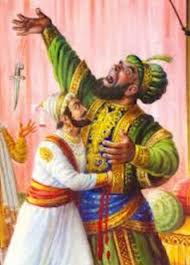

At Pratapgad, foresight met courage, and destiny bent before Shivaji Maharaj’s unyielding will.
In the vast tapestry of Indian history, few moments carry the intensity and consequence of the encounter between Chhatrapati Shivaji Maharaj and Afzal Khan. Set against the rugged terrain of Pratapgad in 1659, this meeting was not merely a clash between two individuals but a turning point that reshaped the balance of power in the Deccan. Shivaji Maharaj, the visionary founder of the Maratha Empire, faced off against Afzal Khan, a formidable general of the Adil Shahi Sultanate, each representing vastly different ideologies, ambitions, and visions for India.
What unfolded during this historic encounter went far beyond a simple battle of strength. It was a moment defined by strategy, foresight, and unshakable resolve. The outcome sent ripples across the subcontinent, inspiring resistance, redefining warfare, and cementing Shivaji Maharaj’s legacy as a master strategist and fearless leader. This article examines the events, motivations, and lasting impact of that pivotal meeting, an episode that continues to resonate through Indian history centuries later.
The Deccan in the Mid-17th Century – A Clash of Empires
In the 1600s, the Deccan plateau was a mosaic of shifting powers and fractured sovereignties. Regional Sultanates like the Adil Shahi of Bijapur and the emergent Maratha forces led by Shivaji were locked in an escalating struggle for control over forts, trade routes, and influence. The Mughals to the north exerted pressure for expansion, while local rulers sought autonomy. Into this volatile landscape stepped Chhatrapati Shivaji Maharaj, a dynamic leader driven by the vision of Swarajya, an independent state rooted in self-rule and local cultural identity.
Afzal Khan, a seasoned general of the Adil Shahi Sultanate, was tasked with subduing Shivaji’s rising influence. Khan commanded a significant army equipped with cavalry, infantry, and artillery, yet he was wary of the guerrilla tactics and intimate knowledge of terrain that characterized Maratha resistance. For both leaders, the tension mounted toward an inevitable confrontation, not merely a battle but a defining moment in the historical evolution of power in western India. Understanding this broader political stage is essential to appreciating the stakes of the encounter that would unfold at Pratapgad, a clash that did not just decide a battle but reshaped regional geopolitics and cemented Shivaji’s legacy.
Shivaji Maharaj – Architect of Swarajya and Strategic Mastermind
Shivaji Maharaj’s ascent was rooted in more than military ambition, it was forged in a strategic worldview that blended tactical ingenuity, cultural resilience, and administrative foresight. Born into a landscape fragmented by feuding powers, he envisioned a polity that placed local governance and grassroots mobilization at its core. This concept of Swarajya would become a rallying cry for those disillusioned with distant imperial authorities. His approach to conflict was marked by adaptability, he exploited the rugged terrain of the Western Ghats, utilized rapid mobility, and pioneered forms of warfare that neutralized larger forces. Shivaji’s command was not just physical but psychological, he understood how to leverage symbolism, timing, and calculated risk to keep his adversaries off balance. It was this blend of audacity and preparation that set the stage for the encounter with Afzal Khan at Pratapgad.
Afzal Khan – Power, Ego, and the March on Swarajya
Afzal Khan was no ordinary commander, he was a veteran of the Adil Shahi military apparatus and trusted to eliminate rebellious obstacles. His reputation was built on battlefield experience and uncompromising loyalty to Bijapur’s ruling elite. Khan’s objective was clear, to dismantle Shivaji’s burgeoning base and prevent the consolidation of Maratha power. His force was well-armed and numerically superior, bolstered by cavalry and infantry well prepared for open combat. But Khan’s campaign was not without internal psychological strain. Legends and some historical accounts describe him as proud and ego-driven, traits that may have clouded his strategic judgment. While historical records vary on the specifics of his motivations, it is evident that Khan underestimated both the terrain and the tactical acumen of his opponent. His advance into Maratha territory appeared confident, but it would soon confront an adversary who turned every expectation on its head.
Ultimately, Afzal Khan’s decision to propose a direct meeting at the foothills of Pratapgad reflected both his confidence and a fatal miscalculation. Believing that negotiation, under his terms, would secure Shivaji’s submission, he underestimated the depth of preparation and resolve of the Maratha king. That misjudgment would define the encounter and seal Khan’s fate.
Road to Pratapgad – Preparation, Deception, and Strategy
As Afzal Khan’s forces advanced, Shivaji Maharaj faced the difficult choice of confronting a larger army or leveraging the rugged landscape to his advantage. Rather than meet them on open ground, he chose Pratapgad, a hill fort whose location offered natural defensive strength and psychological leverage. The route to the meeting point was meticulously prepared, not just for show but as part of a larger operational design. Trees were cleared from main paths to allow Afzal’s troops to advance, while alternate routes were strategically blocked to limit retreat or flanking maneuvers.
Shivaji’s preparations were both subtle and ingenious. He openly accepted the invitation to meet Afzal Khan in neutral territory, but concealed his readiness beneath a calm exterior. Before the encounter, he performed rituals, donned protective armor beneath lightweight clothing, and concealed traditional weapons, including the wagh nakh (tiger claws) and a hidden dagger, that would prove decisive. His small escort was composed of trusted lieutenants skilled in close combat.
By contrast, Afzal Khan agreed to the terms of engagement without adequate suspicion. He entered the meeting accompanied by only a few attendants, expecting a negotiated outcome. Unaware of Shivaji’s precautions, he believed his superior numbers and commanding presence would ensure a favorable resolution. In doing so, he walked into a scenario where perception and preparation were deliberately mismatched.
Beyond the physical preparations, Shivaji’s mindset was shaped by an acute awareness of psychological warfare. He balanced respect with resolve, presenting a welcoming façade while guarding every tactical angle. His choice of time, place, and hidden armament illustrated a deep understanding of both his enemy and his own strengths, a central theme in his enduring military legacy.
The Pratapgad Encounter – Courage, Cunning, and Combat
On 10 November 1659, the two leaders met at a decorated tent at the foothill of Pratapgad. Agreements stipulated that each would be lightly armed, signalling peaceful negotiation. Afzal Khan, dressed in thin garments and carrying only a sword and dagger, advanced confidently. Shivaji approached similarly but wore concealed armor and carried the wagh nakh hidden beneath his sleeve. The moment of contact was decisive. As per multiple historical traditions, Afzal Khan embraced Shivaji in what appeared to be a customary greeting, then attempted to stab or incapacitate him. Shivaji’s armor deflected this assault, and he responded immediately with the wagh nakh, mortally wounding Khan. The ensuing struggle saw Shivaji’s aides counter further attacks, neutralizing Afzal’s key escorts.
Once Khan fell, Shivaji signalled his hidden forces. Cannons fired from Pratapgad marked the beginning of a broader assault that overwhelmed Afzal’s encamped troops below. What began as a tense negotiation turned into a rapid and decisive Maratha victory, with the larger army routed and dispersed.
Immediate Aftermath – Victory and Consolidation
The death of Afzal Khan sent shockwaves through the Adil Shahi command structure. His army, leaderless and disoriented in the dense forests near Pratapgad, crumbled as Maratha forces pressed their advantage. Shivaji’s bold signal, a cannon shot from the fort, coordinated the offensive and underscored the depth of his battlefield planning. In the wake of this victory, the Marathas seized forts, gained prisoners, and captured war materiel. The triumph elevated Shivaji’s reputation among both allies and adversaries, reinforcing the viability of Swarajya as a political and military force. It also forced neighboring powers to reassess their strategic calculations regarding the Maratha state.
Long-Term Significance – Strategy, Statecraft, and Legacy
The encounter at Pratapgad stands as a marker of Shivaji Maharaj’s ascent from regional leader to a symbol of organized resistance against established powers. It demonstrated how judicious use of terrain, psychological insight, and meticulous preparation can enable smaller forces to overcome larger adversaries. This clash didn’t just produce a battlefield victory, it reshaped perceptions of warfare in the Deccan and set a template for future Maratha strategies. Historically, the incident has been remembered not merely as an act of martial prowess, but as an expression of a larger political aspiration, a drive toward self-determination in an era of empire and conquest. Its narrative continues in Indian historical memory as a moment when strategic insight triumphed over raw force.