
Where humility walks in, equality sits, and faith is quietly served.
Amritsar is not just a destination, it is a living narrative where faith, history, and patriotism converge with quiet confidence. At the heart of the city stands the Golden Temple, also known as Sri Harmandir Sahib, a symbol of spiritual equity and timeless resilience. Wrapped in shimmering gold and reflected in the sacred Amrit Sarovar, the temple welcomes people of all beliefs, setting a powerful benchmark for inclusivity and inner peace. The Golden Temple tour is incomplete without experiencing the Langar, the world’s largest community kitchen, where thousands are served free meals every day. This simple act of shared dining carries a profound message of equality, humility, and service, values deeply embedded in Sikh philosophy.
This journey through Amritsar is not just about sightseeing, it is about understanding India’s soul through moments of silence, service, and shared pride.
The Story of Amritsar: A City Born from Faith and Courage
Amritsar is one of India’s most meaningful cities, shaped by spirituality, sacrifice, and strength. The city was founded in the 16th century by Guru Ram Das, the fourth Sikh Guru, who envisioned it as a place of peace and community. At its core was a sacred water tank, later known as the Amrit Sarovar, around which the city slowly grew. Over time, Amritsar became a spiritual centre for Sikhism and a gathering place for seekers from all backgrounds.
As centuries passed, Amritsar witnessed both devotion and hardship. The city faced invasions, political unrest, and colonial rule, yet its spirit never weakened. It became a symbol of resistance and resilience, especially during India’s freedom movement. Events like the Jallianwala Bagh massacre deeply scarred the city, but also strengthened its identity as a place that stands for truth and justice.
Today, Amritsar blends its historical depth with modern energy. Ancient lanes coexist with bustling markets, and spiritual silence meets patriotic pride. The city does not just tell history; it allows visitors to feel it through lived experiences, traditions, and collective memory.
The Golden Temple: History, Architecture, and the Sacred Amrit Sarovar
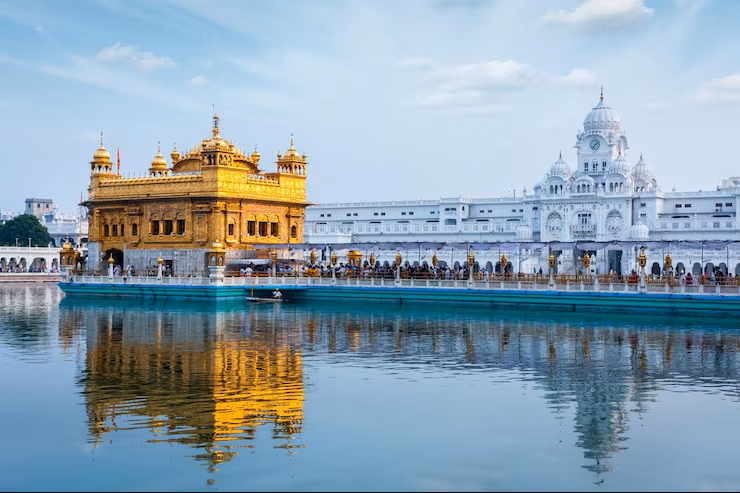
The Golden Temple, known as Sri Harmandir Sahib, is located in the centre of Amritsar, Punjab, and is the most blessed shrine of Sikhism. Its origins date back to the late 16th century, when Guru Arjan Dev, the fifth Sikh Guru, laid the foundation of the temple in 1587. What makes this moment historically significant is that the foundation stone was laid by a Muslim saint, Hazrat Mian Mir, reflecting the Sikh principle of harmony between faiths. From its very beginning, the Golden Temple was designed not as an exclusive religious structure, but as a universal place of worship open to all humanity.
One of the most powerful ideas behind the Golden Temple is its architectural humility. Unlike most temples or religious buildings that stand tall on raised platforms, Sri Harmandir Sahib was deliberately built lower than the surrounding land. Visitors must walk downwards to enter the shrine, symbolising the need to leave ego behind. This design reflects Sikh teachings that humility is the highest virtue and that true devotion begins with equality and self-awareness.
The architectural style of the Golden Temple is a thoughtful blend of Hindu and Islamic influences, representing cultural unity rather than separation. The lower structure is built with white marble, chosen for its purity, calmness, and spiritual symbolism. Above this, the temple is crowned with a gold-plated upper structure, which shines brilliantly under sunlight. This gold covering was added in the early 19th century by Maharaja Ranjit Singh, the founder of the Sikh Empire. His contribution not only enhanced the temple’s beauty but also turned it into a global symbol of Sikh faith and identity.
Another defining feature of the Golden Temple is its four entrances, one on each side of the complex. These doors open toward all directions, clearly communicating that the shrine welcomes people from every region, background, caste, and religion. There is no main gate or privileged entry, reinforcing the Sikh belief that no individual stands above another. Every visitor enters with the same status, united by respect and humility.
Surrounding the temple is the Amrit Sarovar, a large sacred pool from which the city of Amritsar derives its name. “Amrit” means nectar, and “Sarovar” means pool. Devotees believe that bathing in its waters cleanses the soul and brings inner peace. Beyond religious belief, the Sarovar plays a deep emotional role. The still waters reflect the Golden Temple, creating a serene atmosphere that encourages silence, reflection, and spiritual connection.
Within the complex also stands the Akal Takht, established by Guru Hargobind, the sixth Sikh Guru. It represents the concept of “Miri-Piri,” the balance between spiritual authority and worldly responsibility. While the Golden Temple focuses on devotion and prayer, the Akal Takht symbolises justice, leadership, and moral strength, reminding followers that spirituality must guide action in everyday life.
What truly sets the Golden Temple apart is that it is a living place of worship, active day and night. The continuous recitation of the Guru Granth Sahib, Sikhism’s holy scripture, fills the air with sacred sound. This unbroken prayer tradition ensures that the temple is never silent, reinforcing the idea that faith here is not confined to rituals but woven into daily life.
Together, the Golden Temple, Amrit Sarovar, and surrounding structures form more than a religious complex. They represent a complete philosophy of life based on humility, equality, service, and devotion, values that continue to guide millions across the world.
Langar at the Golden Temple: A Living Practice of Equality
The Langar at the Golden Temple is not only a meal service but a daily operation driven by faith, discipline, and collective responsibility. Established by Guru Nanak Dev, the founder of Sikhism, and later strengthened by successive Sikh Gurus, Langar was created to remove social barriers and ensure that no one sleeps hungry. Every single day, the community kitchen at Sri Harmandir Sahib serves free food to tens of thousands of people, and on special occasions or festivals, this number can rise significantly. There is no entry fee, no questions asked, and no distinction made between visitors, pilgrims, tourists, or those in need. Anyone who enters the complex is welcome to eat.
The food served in Langar is intentionally simple yet nourishing, usually consisting of roti, dal, vegetables, and rice. This simplicity carries meaning. The focus is not on luxury but on sustenance and equality. All visitors sit together on the floor in long rows, a practice known as Pangat, which ensures that everyone eats at the same level. There are no separate sections based on age, gender, wealth, or social status. By sharing the same food, prepared in the same kitchen, Langar quietly removes social divisions that exist outside the temple walls.
Behind this massive daily service is the concept of Seva, or selfless service. Thousands of volunteers from different backgrounds contribute their time by chopping vegetables, cooking, serving food, cleaning utensils, and maintaining the kitchen. Many donations come from ordinary devotees who offer grains, vegetables, money, or labor, not for recognition but as an act of devotion. This system runs entirely on collective effort and faith, demonstrating how a community can sustain compassion at scale. Langar at the Golden Temple is not an act of generosity from the powerful to the powerless; it is a shared responsibility that turns equality into everyday practice.
Why Amritsar Should Be on Every Travel List
Amritsar offers something rare, a complete emotional journey. It gives spiritual depth at the Golden Temple, human connection through Langar, and historical awareness through its past. Few cities manage to balance faith, service, and patriotism so seamlessly. The warmth of the people, the simplicity of traditions, and the strength of values leave a lasting impact on visitors. Amritsar does not impress with luxury; it moves with meaning.
A visit to Amritsar is not just travel, it is reflection, learning, and connection. It reminds us that true richness lies in humility, service, and shared humanity.