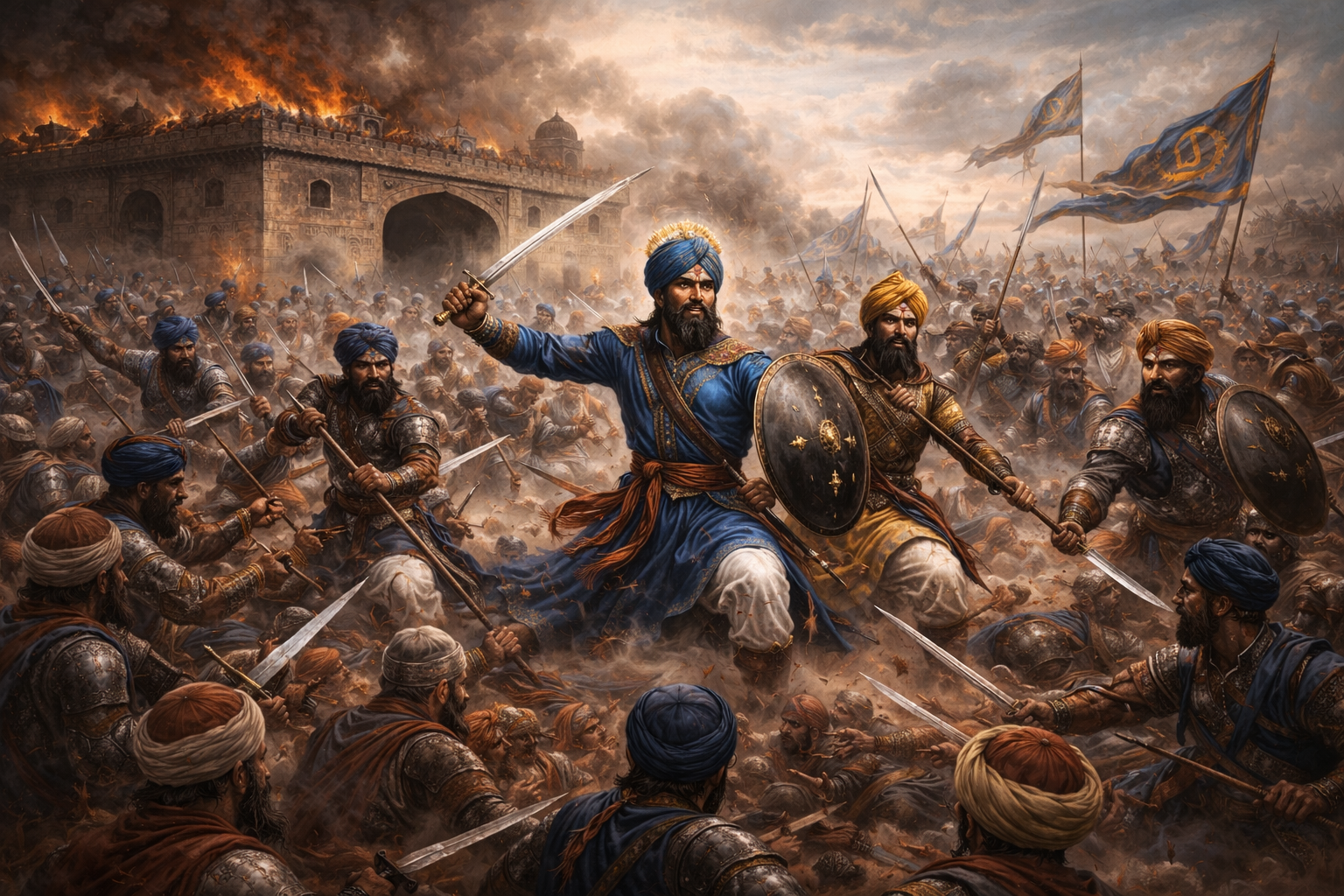

When faith stands firm, even empires fall before unwavering courage.
The Battle of Chamkaur in 1704 stands as one of the most powerful narratives of courage in Indian history, not because of its military scale, but because of its moral magnitude. This was a battle where survival was uncertain, defeat seemed inevitable, and yet surrender was never an option. Guru Gobind Singh Ji, the tenth Sikh Guru, found himself at the center of a defining moment, not just for the Sikh community, but for the broader idea of standing against injustice. Chamkaur was not merely a battlefield; it was a crucible where faith, leadership, sacrifice, and purpose were tested under the harshest conditions. What emerged from this moment was a legacy far greater than victory or loss, a legacy that continues to shape Sikh identity and inspire resistance rooted in righteousness.
Historical Background and Why the Battle Happened
The Battle of Chamkaur cannot be understood without examining the turbulent political and religious environment of early eighteenth-century India. The Mughal Empire under Emperor Aurangzeb was marked by aggressive expansion, centralization of power, and increasing religious intolerance. Independent spiritual movements that promoted equality and challenged authority were seen as threats. Guru Gobind Singh Ji’s establishment of the Khalsa in 1699 directly confronted these structures by empowering ordinary people with courage, discipline, and spiritual sovereignty. This transformation alarmed both Mughal officials and local hill chiefs, who feared the growing unity and influence of the Sikhs.
The prolonged siege of Anandpur Sahib was a calculated attempt to weaken the Guru and dismantle Sikh resistance. When false promises of safe passage were made and later broken, it became clear that the conflict was no longer about territory, it was about silencing an idea. The relentless pursuit that followed forced the Guru and his followers into a defensive struggle, making the Battle of Chamkaur an unavoidable stand against betrayal and oppression.
When the Battle Took Place, Where It Happened, and Who Was Involved
The Battle of Chamkaur took place in December 1704, at a time when Guru Gobind Singh Ji and his followers were already enduring extreme physical hardship and emotional trauma. The winter season added to their suffering, as cold weather, lack of food, and constant movement had weakened the Sikh forces during their retreat from Anandpur Sahib. This retreat itself was the result of repeated betrayals, broken promises of safe passage, and continuous attacks by Mughal forces and allied hill chiefs. After days of separation from family members, loss of companions, and relentless pursuit, Guru Gobind Singh Ji finally reached Chamkaur, a small town in present-day Punjab, India. With very limited options for shelter, the Guru and his remaining companions, approximately forty Sikh warriors, took refuge in a small fortified house, often described as a mud fort. Though modest in structure, this fort became a critical defensive position and the final stand against the advancing enemy.
Alongside Guru Gobind Singh Ji were his two elder sons, Sahibzada Ajit Singh Ji, aged eighteen, and Sahibzada Jujhar Singh Ji, aged fourteen. Their presence on the battlefield reflected the values of the Khalsa, where age and status did not limit one’s responsibility toward faith and justice. Facing this small group was a massive Mughal army, supported by local hill rulers, numbering in the thousands. These forces were well-armed, well-supplied, and confident of victory due to their overwhelming numerical strength. This severe imbalance shaped the battle from the very beginning, turning it into a test of endurance rather than a conventional military engagement. However, what the Sikh forces lacked in manpower, they made up for through discipline, unity, and unshakable faith. Within the walls of the Chamkaur fort, fear gradually gave way to determination, and strategic calculation was replaced by moral resolve. The fort thus became more than a defensive structure, it became a symbol of resistance, where conviction stood firm against cruelty and courage confronted power head-on.
The Martyrdom of Sahibzada Ajit Singh Ji and Sahibzada Jujhar Singh Ji
As the Battle of Chamkaur grew more intense, the small fort echoed with the sounds of continuous attack, yet within its walls stood an unshaken resolve. Guru Gobind Singh Ji understood that the enemy would not retreat easily and that the defense could not last forever. At this critical moment, Sahibzada Ajit Singh Ji, the eldest son of the Guru, stepped forward and requested permission to face the enemy on the battlefield. At just eighteen years of age, he was already a trained warrior and a leader among the Khalsa. His request was not driven by emotion or desperation, but by a clear understanding of duty and sacrifice. With a composed heart and deep faith, Guru Gobind Singh Ji granted permission, fully aware of the price this decision would demand. Sahibzada Ajit Singh Ji entered the battlefield with remarkable courage, fighting fiercely against the Mughal soldiers until he attained martyrdom. His sacrifice became a defining moment of the battle, strengthening the morale of the Sikhs and shaking the confidence of the opposing forces.
Soon after the martyrdom of Sahibzada Ajit Singh Ji, an even more profound moment unfolded. Sahibzada Jujhar Singh Ji, only fourteen years old, approached his father with the same request, to join the fight. Despite his young age, his resolve reflected the core values of the Khalsa. Fearlessness, devotion, and unwavering faith. Guru Gobind Singh Ji, embodying both a father’s pain and a leader’s responsibility, allowed him to go. Sahibzada Jujhar Singh Ji entered the battlefield with extraordinary determination, engaging the enemy with courage far beyond his years. His martyrdom left a deep impact on both sides, revealing that spiritual strength and moral clarity can surpass physical age and military power. His sacrifice further transformed the battle into a spiritual stand, where faith and righteousness outweighed survival.
Alongside the Sahibzadas, the remaining Sikh warriors continued to fight with complete awareness of their fate. Each step onto the battlefield was a conscious choice, guided by commitment to the Guru and the principles of the Khalsa. These warriors did not fight for victory in the conventional sense, but to uphold dignity, truth, and resistance against injustice. Their sacrifices elevated the Battle of Chamkaur from a mere military conflict to a timeless example of courage rooted in faith. The martyrdom of Sahibzada Ajit Singh Ji and Sahibzada Jujhar Singh Ji became a cornerstone of Sikh history, symbolizing that the defense of righteousness stands above life itself and that true legacy is forged through sacrifice, not survival.
Escape of Guru Gobind Singh Ji
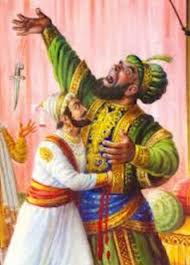
As darkness fell and the fort stood on the edge of collapse, the situation demanded a decision that balanced sacrifice with continuity. It became evident that the survival of Guru Gobind Singh Ji was essential for the future of the Sikh movement. Through careful planning and the extraordinary devotion of Sikhs like Bhai Sangat Singh, who resembled the Guru and drew enemy attention, a strategic deception was executed. Under the cover of night, Guru Gobind Singh Ji escaped the fort, ensuring that the flame of resistance would not be extinguished. Though the Mughal forces occupied Chamkaur, they failed in their true objective, to destroy the Sikh spirit. The Battle of Chamkaur concluded not as a defeat, but as a moral triumph that reinforced the foundations of Sikh resilience. Today, Chamkaur Sahib stands as a timeless reminder that when faith guides action and courage leads the way, even the smallest force can challenge empires and leave an indelible mark on history.
What happened after Chamkaur reshaped Sikh history. The battle became a moral benchmark, a reminder that true power does not lie in dominance, but in standing firm when everything is at stake. Chamkaur marked the transition from survival to resurgence, from defense to renewed resistance. In that sense, the battle did not end at the fort—it echoed forward, carrying its message through generations: when faith leads, and courage follows, even the smallest force can alter the course of history.