
The Battle of Panipat (1526): A Comprehensive Analysis
The First Battle of Panipat, fought on April 21, 1526, was one of the most decisive conflicts in Indian history. Beyond being a clash of armies, it marked a turning point in the subcontinent’s political and cultural trajectory. The battle occurred near the town of Panipat in present-day Haryana, approximately 90 kilometers north of Delhi. It set the stage for the rise of the Mughal Empire and the decline of the Delhi Sultanate, reshaping the very fabric of Indian governance, warfare, and society.
This confrontation was not merely a military engagement; it represented a collision of visions for India’s future. Babur, the Central Asian invader, brought innovation, discipline, and technological advantage, while Ibrahim Lodhi, the Sultan of Delhi, represented the traditional Indian-Islamic power structures. Their clash would alter not only territorial control but also military strategies, political alliances, and cultural patterns for centuries to come.
Political Background
The early 16th century in northern India was a period of political fragmentation and instability. The Delhi Sultanate, under the Lodhi dynasty, had ruled for nearly 60 years, but internal strife weakened the state. Ibrahim Lodhi, the last Lodhi Sultan, faced constant rebellion from provincial governors and nobles (rajas and amirs) who were dissatisfied with his centralizing policies. Unlike his predecessors, Ibrahim lacked political tact and personal charisma, creating a vacuum of loyalty among his generals.
At the same time, smaller regional powers, such as the Rajputs of Mewar, the Afghans of eastern Punjab, and various northern chieftains, were vying for autonomy or influence. This unstable political environment created a fertile ground for an ambitious outsider to intervene and exploit internal divisions.
Babur: The Invader
Babur, a descendant of Timur on his father’s side and Genghis Khan on his mother’s, had spent decades navigating the turbulent politics of Central Asia. After repeated attempts to regain Samarkand, he turned his attention toward India, drawn by its wealth and the evident weaknesses of the Lodhi dynasty. Several Indian nobles, dissatisfied with Ibrahim Lodhi’s rule, actively sought Babur’s intervention. Daulat Khan Lodi of Punjab invited him to enter India with the promise of local support, supplies, and strategic alliances. Babur’s invasion was therefore both opportunistic and diplomatically calculated, leveraging the discontent within the Sultanate to strengthen his position before the battle.
Causes of the Battle
The causes of the battle were both strategic and personal. Babur’s ambitions were fueled by his desire to extend his control southward into India, drawn by fertile lands, immense wealth, and political instability. The Lodhi dynasty’s fragility created an opportunity, as many regional chieftains and nobles, dissatisfied with Ibrahim Lodhi’s rule, were ready to support an invader who promised stability or reward. The stage was set for a confrontation that would combine conventional warfare with innovative military tactics.
The Battle of Panipat (April 21, 1526)
The First Battle of Panipat was a confrontation between two very different armies in both size and tactics. Babur, leading a relatively small but highly disciplined force of around 12,000 men, positioned his troops in a defensive crescent-shaped formation. The center consisted of infantry and artillery units sheltered behind araba carts, which were chained together to form a mobile barricade. The flanks were held by cavalry units ready to execute rapid flanking maneuvers, while reserves were kept behind the center to respond to any breakthroughs or emergencies. In contrast, Ibrahim Lodhi commanded a massive army of about 100,000 soldiers, including 1,000 war elephants and tens of thousands of cavalry. Lodhi deployed his troops in a conventional linear formation, with elephants at the front to charge and break enemy lines, infantry behind them, and cavalry on the flanks, relying heavily on sheer numbers and intimidation rather than maneuver.
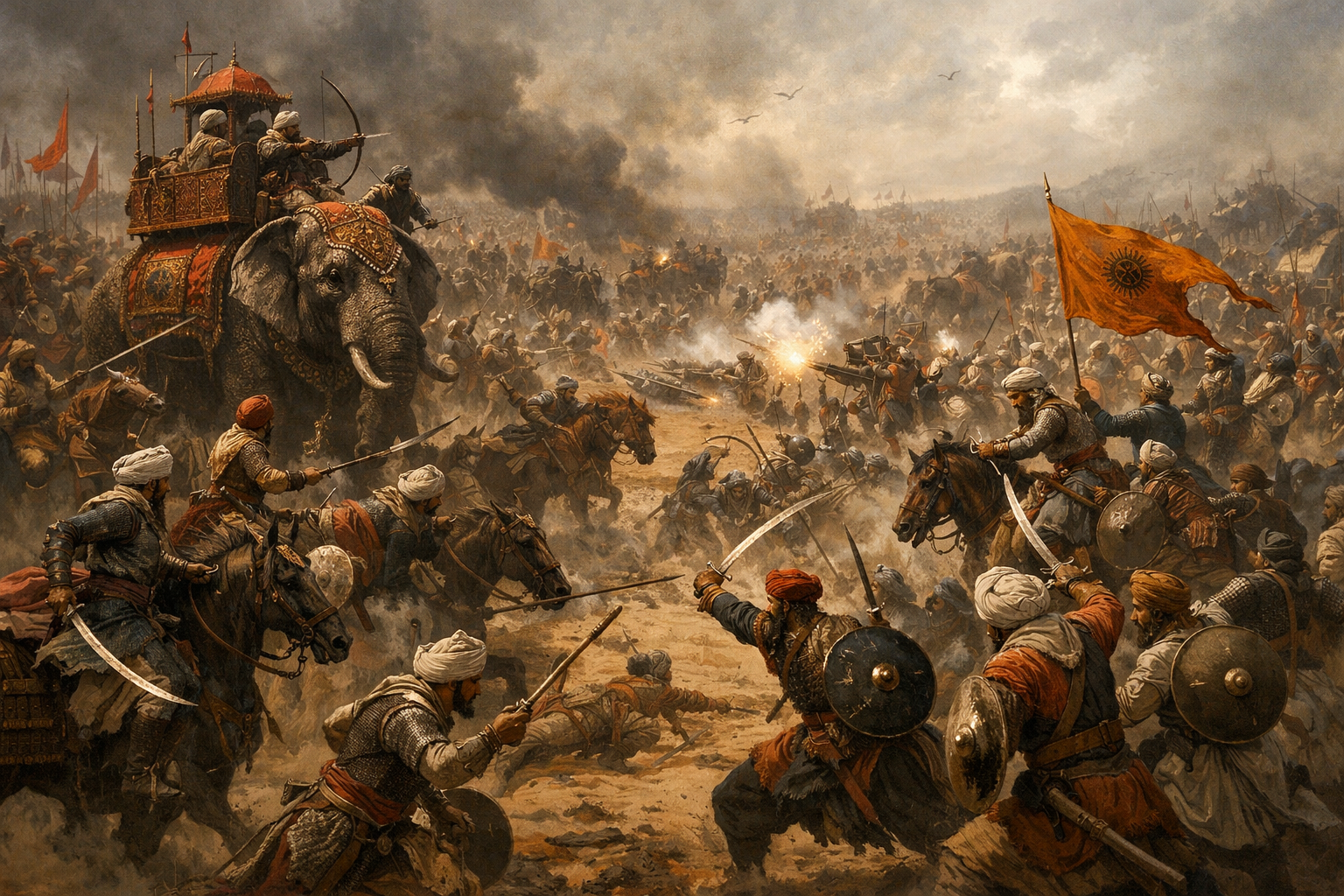
The battle began in the early morning with Lodhi’s army advancing across the plain toward Babur’s positions. As the elephants and cavalry charged, Babur’s artillery opened fire from behind the chained carts, immediately causing panic among the elephants. Many of these panicked elephants trampled their own soldiers, creating confusion in Lodhi’s ranks. Meanwhile, Babur’s infantry maintained continuous volleys of arrows and matchlock gunfire, further disrupting the forward advance and inflicting casualties before the enemy could even reach the defensive line. The initial engagement demonstrated the decisive impact of artillery in controlling the battlefield and neutralizing the advantage of superior numbers.
As the battle progressed, Babur’s flanking units executed the tulughma strategy, attacking the sides of Lodhi’s army while the center held firm. Some of Babur’s units performed feigned retreats to draw parts of Lodhi’s forces into traps, exploiting the gaps created in the massive but poorly coordinated army. The combination of frontal artillery fire and aggressive flanking caused Lodhi’s formations to fragment gradually, as the troops struggled to maintain cohesion under simultaneous attacks from multiple directions.
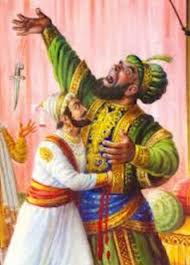
By midday, the center of Lodhi’s army began to collapse. The panicked elephants trampled the infantry, spreading disorder throughout the ranks. Babur’s reserves were brought forward to tighten the encirclement, cutting off escape routes and ensuring that Lodhi’s soldiers could not regroup. The battle reached its decisive moment when Ibrahim Lodhi himself was killed in the melee. His death shattered the morale of his remaining forces, leading to a complete rout. Babur’s cavalry pursued the fleeing soldiers, ensuring that no significant portion of the enemy could recover or counterattack. By late afternoon, the battlefield was entirely under Babur’s control, marking a decisive victory.
Several tactical factors contributed to Babur’s success. The superiority of artillery disrupted Lodhi’s elephants and infantry, the flanking and encirclement maneuvers neutralized the numerical advantage of his opponent, and the use of araba carts provided both protection and stability for effective gunfire. Above all, Babur’s disciplined, coordinated, and mobile army outmaneuvered Lodhi’s larger but less organized force. The Battle of Panipat thus became a landmark in military history, demonstrating how strategy, technology, and leadership could triumph over sheer size and traditional methods of warfare.
Conclusion
The First Battle of Panipat was not just a military confrontation but a transformative moment in Indian history. It demonstrated the decisive impact of leadership, technology, and strategy over mere numbers. Babur’s victory reshaped political boundaries, military practices, and cultural trajectories, creating a foundation for the Mughal Empire that would profoundly influence India’s history for centuries. It also illustrated a timeless lesson: in history, innovation, timing, and vision often outweigh brute force and tradition.