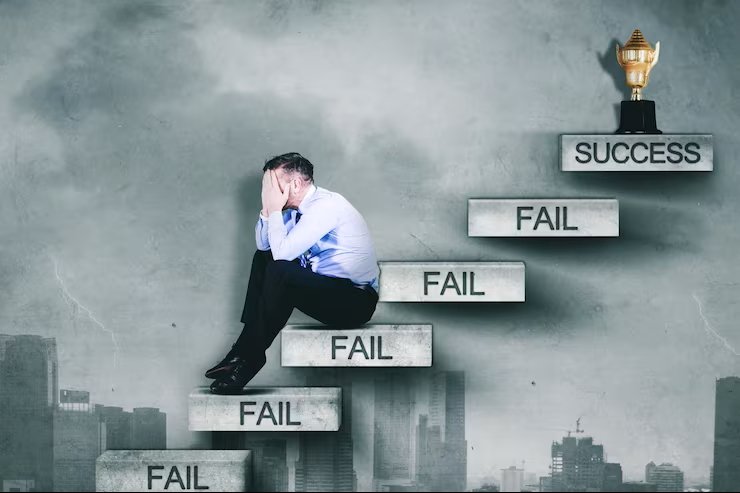

Failure is not the end of the story, only the page that turns you.
I still remember the exact chair I was sitting in when I found out I hadn’t gotten a job I genuinely believed was mine. Not close to mine. Actually mine. I had already imagined the desk, the commute, the people I would meet, and even the small dinner I had planned to celebrate. Then came a polite email, a quiet disappointment, and an evening that suddenly felt much longer than it should have. For a while, I couldn’t help but wonder, What went wrong?
Most of us have experienced a moment like that. A job we wanted, a relationship we valued, a goal we worked hard for, or a plan we believed would finally work out only to watch it fall apart. Failure has a strange way of making us question ourselves. But the truth is, failure is not a sign that we are incapable. Sometimes, it is simply life telling us that our story is taking a different direction.
Over time, I learned that setbacks can carry lessons that success often hides. They teach patience when we want quick results, resilience when things become difficult, and courage when we have to start again. What feels like a painful ending today can become a valuable chapter in our growth tomorrow.
We cannot control every outcome, but we can control what we do next. We can learn, adapt, improve, and keep moving forward. Failure may knock us down, but it doesn’t have to define us. Sometimes, it is the very thing that helps us rise stronger, wiser, and better prepared for what comes next.
What You’re Actually Made Of
There’s a strange kind of clarity that shows up right after something falls apart. You find out fairly fast whether you’re someone who stays down, or someone who, even reluctantly, drags themselves up the next morning anyway.
Nobody knows which one they are until they’re actually tested. It’s easy to imagine yourself as resilient when nothing’s gone wrong yet. Talk is cheap that way.
I’ve noticed this in people around me too. The ones who eventually built something worth having, a stable career, a good relationship, a business that actually holds up, almost all of them have a failure story sitting somewhere in the middle of it. Not despite it. Because of what it quietly forced them to learn about themselves.
It’s not romantic while it’s happening, by the way. Nobody feels grateful in the moment. That gratitude, if it ever shows up, usually arrives much later, looking backward.
The Ego Gets Stripped Away, Slowly
Success has this funny way of making people believe their own hype a little too much. Failure does the opposite. Sometimes gently, sometimes not so gently, it forces you to actually look at your limitations instead of just your highlight reel.
Not a bad thing, even though it feels awful at the time. A little humility tends to make people easier to work with. Easier to love, honestly. Easier to actually learn from.
Who Actually Shows Up
Here’s something failure reveals that success almost never does.
When things go well, everyone’s around. Everyone’s cheering, everyone wants a piece of the good news. But when things fall apart, the crowd thins out fast, and what’s left is usually the small handful of people who actually matter.
That’s not cynicism. It’s just true. And weirdly, it’s a gift disguised as a hard moment, because you stop wasting energy on relationships that were only ever built on convenience, and you start noticing the ones that were real the whole time.
- Realizing which friendships were surface-level all along
- Appreciating the few people who stayed without being asked to
- Learning to lean on support instead of hiding failure out of shame
- Building real trust with the people who saw you at your lowest
Your Relationship with Fear Changes
Before you’ve actually failed at something big, failure feels enormous. Almost unbearable to even imagine. It’s this looming shadow that keeps people frozen, unwilling to try new things because the risk feels too heavy to carry.
But once you’ve failed, and survived it, genuinely survived it, that shadow shrinks. You’re still standing. Still breathing. Still, somehow, capable of trying again.
That realization quietly rewires how much power fear has over your future decisions. Doesn’t vanish completely. It just stops running the whole show.
Patience, in a World That Hates Waiting
We live in a strange time where everyone expects results almost instantly, and failure interrupts that in a way that forces patience whether you want it or not.
Recovering doesn’t happen on a fast timeline. Rebuilding doesn’t either. No matter how badly you want it to.
Learning to sit with that slower pace, without constantly comparing your recovery to someone else’s highlight reel online, is its own quiet lesson that ends up spilling into other parts of life too.
Small Failures Prepare You for Bigger Ones
Nobody starts with the massive, life-altering failure as lesson one. Usually it’s smaller stuff first. A missed deadline. An awkward conversation gone sideways. A plan that just didn’t pan out the way you thought it would. These smaller stumbles are quietly training you for the bigger ones down the road. Teaching you how to fall without completely shattering when it happens.
What Success Actually Means Shifts
Before failure, success often looks like a checklist borrowed from somebody else’s life. The job title. The salary number. The timeline you assumed you’d hit by a certain age, for reasons you never really questioned.
After failure, that definition tends to get quietly rewritten into something more personal. More honest. Usually far less about impressing anyone watching from the outside.
That shift alone is worth the discomfort it takes getting there.
Starting Over Gets Easier
The first time you have to start over, it feels like the world’s ending. By the third or fourth time, and most people who’ve lived a little have had a few, starting over starts to feel almost familiar. Less catastrophe, more just another chapter that needs writing.
- Building comfort with uncertainty instead of fearing it constantly
- Developing a quiet confidence that you can rebuild when it’s needed
- Letting go of the idea that one setback defines the whole story
- Treating each new start as informed by the last one, not identical to it
Separating Your Worth from Your Outcomes
Probably the hardest lesson on this whole list. One a lot of people spend their entire lives still working on, honestly, myself included some days.
Failing at something doesn’t make you a failure as a person. Even though it feels exactly like that in the moment it happens. Learning to hold those two things apart, the outcome and your own worth, is quietly one of the most freeing lessons life hands you. Takes a good number of failures to actually start believing it though.
That rejection email from years ago barely registers as painful anymore. It just registers now as a turning point I didn’t recognize while it was actually happening. That’s usually how it works with failure. Rarely feels meaningful in the moment. Only afterward, once you’ve had time to see what it quietly built inside you.
If there’s one thing worth holding onto from all this, it’s probably this. Failure isn’t proof that you weren’t enough. More often, it’s just proof that you were finally brave enough to try something that actually mattered to you.