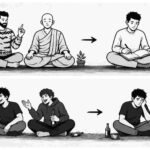

The room that keeps you safe is the same room that keeps you small.
Think about who you were a few years ago. Louder, maybe, Quicker to talk. Not scared of a phone ringing. Somewhere along the way, that changes for a lot of people. Slowly. So slowly you don’t even notice it happening. School kid who used to give speeches turns into an adult who avoids eye contact with strangers. Nobody decides this on purpose. It just builds, one skipped conversation at a time, one day spent indoors instead of out, until the walls around you are thicker than you ever meant them to be. This isn’t about being lazy or “just an introvert.” It’s about comfort, and what it quietly does to a person if nobody pushes back against it.
What a Comfort Zone Actually Is
Forget the buzzword version. A comfort zone is just the space where nothing surprises you. No risk. No embarrassment. Your brain loves it here, honestly, it’s efficient, low-stress, easy. Sounds nice. Except easy and unchanging tend to be the same thing, and unchanging is a problem if you actually want a different life than the one you’ve got right now.
The sneaky part is it never feels like a trap while you’re inside it. It feels like rest. Sometimes it genuinely is rest. But there’s a thin line between recharging and hiding, and most people only see which side they were on after the fact, looking back at some old version of themselves who did things current-you wouldn’t dream of trying.
How It Creeps In Without You Noticing
Nobody wakes up and decides “today I become withdrawn.” It’s gradual. That’s exactly what makes it dangerous. School forces interaction on you, whether you like it or not, so you talk without overthinking it. Then that structure disappears, college, work, real adult life, and suddenly silence is an option. Once it’s an option, people take it. Again. And again. Until quiet stops being a choice and just becomes who they are.
A few years of that, and staying in stops being a preference. It’s the default now. Leaving the house feels like effort instead of just… normal Tuesday stuff. Even a phone call starts to feel like a performance you didn’t rehearse for. None of this means something’s broken in a person. It means comfort is sticky, and every day you don’t test it, the walls get a bit thicker.
The Overthinking Trap That Comes With It
Here’s the part nobody warns you about: shrink your world, and you don’t just get quieter, you get louder inside your own head. Less real interaction means more time alone with your thoughts, replaying conversations that haven’t even happened yet, running worst-case scenarios for a phone call before you’ve even picked up the phone.
Overthinking and comfort zones feed each other. You skip the interaction because it feels unsafe. Skipping it gives your brain free time to imagine everything that could go wrong. That imagined disaster makes the next interaction feel scarier than the last one. Round and round. Each loop makes the walls a little sturdier.
Funny thing is, the imagined version is almost always worse than what actually happens. But you’d never know that unless you actually make the call, which is exactly the thing overthinking talks you out of.
Comfort Feels Safe, But It’s Really Just a Slow Stall
Nothing about comfort feels dangerous in the moment. That’s the whole trick of it. It doesn’t hurt. It just quietly stops everything that would’ve made you sharper, braver, more capable. No risk, sure, but also no practice, no wins, no proof to yourself that you can actually handle hard things when they show up.
Real growth almost never happens in comfort. It happens in that uncomfortable middle zone, hard enough to stretch you, not hard enough to break you. Stay too long where it’s easy, and that stretch just never comes. Skills stay flat. Confidence stays flat. A lot of life ends up flat too.
What Staying Small Actually Costs You
Easy to underestimate this cost, because the losses don’t send you a notification. Nobody tells you “you missed a friendship because you didn’t reply to that text” or “you missed a job because you stayed quiet in that meeting.” It’s just absence. Quiet. Things that never happened because taking them meant stepping outside the safe zone first.
Some of what tends to quietly disappear:
- Friendships that never go deeper than surface-level small talk
- Career moves skipped out of fear of the unfamiliar
- Confidence that fades from lack of use, like a muscle never worked
- An old version of you that slowly got left behind
Why Small Discomfort Is the Actual Cure
Nobody’s telling you to walk into a packed room tomorrow and force a speech. That’s not it. Overcorrecting like that usually just backfires anyway. The real way out is smaller. Answer the call instead of letting it ring out. Add one extra sentence to a conversation instead of the bare minimum. Leave the house for something pointless, just to prove to yourself you still can.
None of that feels like much on its own. But it teaches your brain something, with actual proof, that discomfort isn’t the same thing as danger. That’s really the whole mechanism here. You’re not trying to kill the fear. You’re just proving, one small rep at a time, that you can walk through it and come out fine.
Reframing Discomfort as a Signal, Not a Warning
Most people treat discomfort like a stop sign. Feel nervous, back off, stay safe. But discomfort is often just a sign you’re doing something that actually matters, something that changes you if you stick with it a bit longer. There’s a real difference between fear protecting you from genuine danger and fear protecting your comfort. Learning to tell those two apart is honestly most of the work.
Small Daily Habits That Quietly Rebuild Confidence
Confidence doesn’t show up fully formed one morning. It’s built, slowly, from small repeated actions. Talking to one new person a week. Picking up the call you’d normally let go to voicemail. Saying yes to something your gut wants to decline out of habit, not actual unwillingness. None of these feel heroic while you’re doing them. That’s exactly why they work, small enough to keep repeating.
Weeks of that, months of that, and it stacks into something bigger than any single step, a person who stops flinching at things that used to feel unbearable. Not because the fear disappeared. Because you’ve practiced walking through it enough times that it stopped being the whole story.
Growth Doesn’t Mean Becoming a Different Person
None of this means forcing yourself to become loud, or someone who thrives on constant social noise, if that was never really you to begin with. It just means not letting fear write the rules for your whole life. Some people are naturally more reserved, and that’s fine, genuinely, that’s not the issue here. The issue is when withdrawal stops being a personality trait and turns into a wall, built brick by brick, out of moments you kept avoiding.
Conclusion
If any of this sounds like you, if you can trace your own shift from someone who used to talk freely to someone who now hesitates before a simple phone call, you’re not broken. You’re not alone in it either. Comfort zones get built slowly, out of choices that felt small and harmless at the time. Good news is, they come apart the same way. One small, slightly uncomfortable choice at a time. Nobody’s asking for some dramatic overnight change. Just the next step, the one that feels a bit too uncomfortable to take, taken anyway. That’s really the whole secret. Growth was never on the other side of comfort. It was always just one step past it.