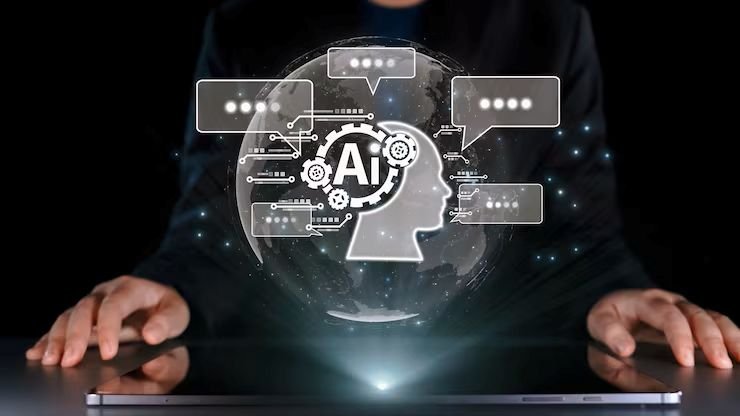

A machine can predict your words, but never truly feel the silence between them.
My uncle asked me last week if the “robot in his phone” was going to take over the world. He was only half joking. That’s the thing about artificial intelligence right now, everyone’s heard the term, most people use it daily without realizing it, and yet somehow it still feels like this mysterious, slightly scary thing happening somewhere far away in a lab. It isn’t. It’s in your phone’s keyboard predicting your next word. It’s in the playlist that somehow always knows your mood. It’s already here, quietly, and it has been for longer than most of us think.
So let’s actually break this down properly, without the jargon, without the sci-fi movie imagery, and just talk about what AI really is, how it works, and why it matters to someone who isn’t a programmer or a tech researcher.
What Artificial Intelligence Actually Means
Strip away the buzzwords and AI is really just this: teaching a computer to recognize patterns and make decisions based on those patterns, instead of following one fixed set of instructions like older software used to. A regular calculator does exactly what it’s told, nothing more. AI, on the other hand, looks at huge amounts of information, spots patterns in it, and then uses those patterns to make a guess, a prediction, or a decision.
That’s genuinely it. There’s no consciousness, no secret thinking happening behind the scenes, no plotting. It’s pattern recognition at a massive scale, running faster than any human brain possibly could.
How Machines Actually Learn
Here’s where it gets interesting, and honestly, a little humbling. Machines “learn” by looking at enormous piles of examples. Show a system a million pictures labeled “cat” and a million labeled “not cat,” and eventually it gets frighteningly good at telling the difference, even in a photo it’s never seen before.
This process is called machine learning, and it’s the engine behind almost everything we call AI today. The system isn’t being told the rules of what makes something a cat. Whiskers, ears, that general shape. It’s figuring that out on its own, purely from staring at examples over and over until the pattern sort of clicks into place.
What’s wild is that nobody, not even the engineers who built the system, can always explain exactly why it made a specific decision. It’s a bit like teaching a child through pure repetition rather than rules, and then being surprised when they develop their own instincts you didn’t explicitly teach them.
- Learning from massive amounts of labeled examples
- Improving accuracy the more data it sees
- Spotting patterns humans might miss entirely
- Sometimes making decisions even its creators can’t fully explain
Where You’re Already Using AI Every Day
This is the part that surprises most people. You don’t need to seek out AI. It’s already woven into things you touch constantly. Your phone’s face unlock, that’s AI. The way Netflix somehow suggests exactly the show you end up loving, also AI. Spam filters quietly catching junk mail before it hits your inbox, AI again.
Even something as simple as typing a text message and having your keyboard predict the next word before you finish typing it, that’s a small AI model working in the background, learning from how millions of people typically write.
Chatbots and Language Models
This one’s probably the reason AI suddenly feels like it’s everywhere. Tools that can write essays, answer questions, hold a conversation, they’ve made AI feel personal in a way it never did before. Talking to a chatbot feels different from watching a Netflix recommendation happen quietly in the background.
These systems work by predicting, word by word, what’s most likely to come next in a sentence, based on patterns learned from enormous amounts of text. It sounds almost too simple to produce something that reads like a real conversation, but at a massive enough scale, that simple trick starts looking a lot like understanding, even though technically, it’s still just very sophisticated pattern prediction.
It’s worth remembering that these systems don’t actually “know” things the way a person does. They don’t have memories of a childhood, or opinions shaped by lived experience. They’re incredibly good at sounding like they do, which is a genuinely different thing, even if the line between the two keeps getting blurrier.
And that blur is exactly why people find this technology both exciting and a little unsettling at the same time.
AI in Healthcare
Doctors are increasingly using AI to help spot things the human eye might miss, tiny irregularities in scans that could indicate cancer at an early stage, patterns in patient data that hint at risks before symptoms even show up. It’s not replacing doctors. Think of it more like a very sharp-eyed assistant who never gets tired and never overlooks a detail because it’s the end of a long shift.
The Real Risks Worth Talking About
Now, the part people actually worry about, and honestly, some of that worry is fair. AI systems learn from data created by humans, which means they can pick up our biases too. If the data used to train a system reflects unfair patterns from the real world, the AI can end up repeating, even amplifying, those same unfair patterns without anyone intending it.
There’s also the question of jobs. Certain repetitive tasks are genuinely at risk of being automated, and pretending otherwise doesn’t help anyone prepare for what’s actually coming.
And then there’s the harder, murkier stuff. Deepfakes that look convincingly real. Misinformation that spreads faster because it was generated instantly rather than researched. Privacy concerns around just how much of our data these systems are quietly trained on.
None of this means AI is inherently bad. It means it’s powerful, and powerful things always need careful handling, the same way electricity was both revolutionary and dangerous when it was first harnessed.
- Bias in AI systems reflecting flawed training data
- Job displacement in certain repetitive roles
- Deepfakes and convincing misinformation spreading faster
- Ongoing concerns around data privacy and consent
Why AI Isn’t Actually “Thinking”
Here’s something worth sitting with for a second. When a chatbot responds to you with something that sounds thoughtful, it isn’t thinking in any way close to how you or I think. It has no awareness that it exists, no feelings about the conversation, no memory of you tomorrow unless it’s specifically designed to keep one. It’s an incredibly advanced calculator for language and patterns, dressed up in a conversational tone that makes it feel far more alive than it actually is.
The Road Ahead for Artificial Intelligence
Where this goes next is genuinely hard to predict, and anyone claiming total certainty is probably overselling their own expertise. What does seem likely is that AI will keep getting woven deeper into daily life, quietly, the same way electricity or the internet did, until eventually we stop noticing it as something separate and start treating it as just part of how things work.
The people and companies who figure out how to use it responsibly, without losing sight of the human judgment behind it, will probably end up ahead. The ones who treat it as some kind of magic fix for everything are likely to be disappointed, or worse, careless with something that deserves a bit more respect than that.
So, is AI going to take over the world like my uncle worries about? Almost certainly not, at least not in the dramatic, movie-villain sense. But is it already reshaping how we work, communicate, and make decisions? Absolutely, and mostly in ways so ordinary now that we’ve stopped even noticing. Understanding it, even just a little, feels less like optional homework these days and more like basic literacy for the world we’re actually living in.