
“Every journey to the Moon begins with courage, not the certainty of success.”
In the year 2019, when Chandrayaan-2 was launched, millions of Indians watched it live with excitement. Unlike Chandrayaan-1, which had successfully orbited the Moon and made groundbreaking discoveries, Chandrayaan-2 carried an even bigger dream. This time, India wasn’t just planning to study the Moon from above, India also wanted to land on it and explore its surface with a rover.
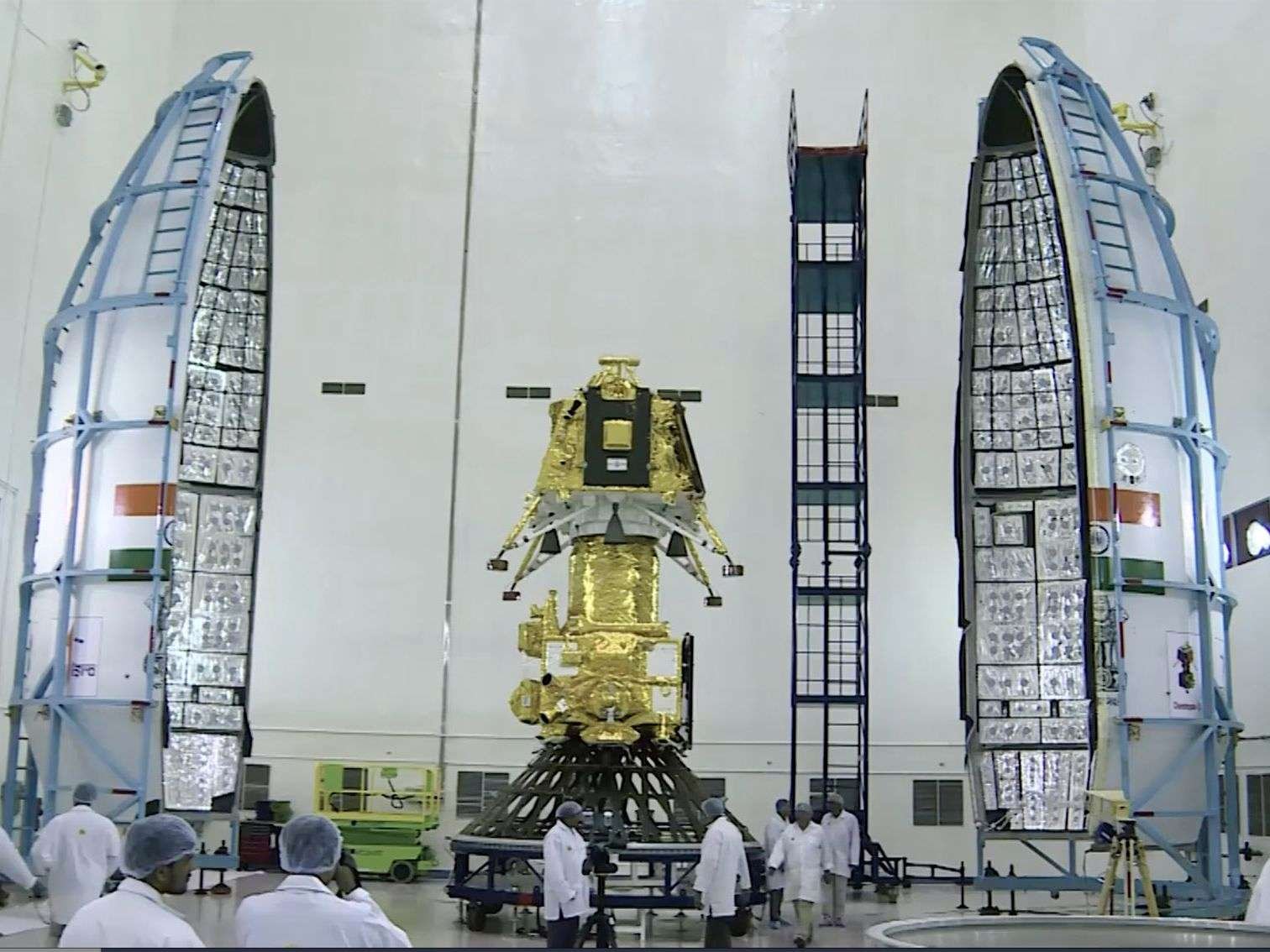
The mission represented one of the most ambitious projects ever undertaken by the Indian Space Research Organisation (ISRO). It combined three spacecraft into one mission an orbiter to study the Moon from space, a lander named Vikram to make a soft landing, and a six-wheeled rover called Pragyan to explore the lunar surface. If successful, India would become only the fourth nation to achieve a soft landing on the Moon.
On 22nd July 2019, Chandrayaan-2 lifted off from the Satish Dhawan Space Centre in Sriharikota aboard the powerful GSLV Mk III-M1 rocket. Over the next few weeks, the spacecraft slowly travelled nearly 384,000 kilometres before entering lunar orbit. Every stage of the journey worked almost exactly as planned, bringing India closer than ever to its first Moon landing.
The mission is often remembered for the few minutes before landing, when communication with Vikram was suddenly lost. Those moments dominated headlines across the world, leading many people to believe Chandrayaan-2 had failed. But the reality is far more interesting. While the lander couldn’t complete its descent, the orbiter continued working perfectly and has spent years studying the Moon, sending back valuable scientific data that researchers continue to use today.
Looking back, Chandrayaan-2 wasn’t just another lunar mission. It became one of ISRO’s greatest learning experiences, proving that even when space missions don’t go exactly as planned, they can still achieve remarkable success and pave the way for even greater achievements.
From Orbiting the Moon to Landing on It
After Chandrayaan-1 discovered evidence of water molecules on the Moon in 2008, scientists around the world became increasingly interested in the Moon’s south polar region. It was believed that permanently shadowed craters near the poles could contain frozen water ice, something that could prove essential for future human exploration and long-term lunar bases.
ISRO wanted its next mission to go much further than simply orbiting the Moon. The goal was to demonstrate that India had developed the technology needed for a controlled soft landing one of the most difficult challenges in space exploration. Unlike placing a spacecraft into orbit, landing requires the spacecraft to slow down from thousands of kilometres per hour with extreme precision. Even a small mistake in speed, altitude, or direction can cause a crash.
Originally, Chandrayaan-2 was planned as a joint mission between India and Russia. Under the agreement, ISRO would develop the orbiter while Russia would build the lander. However, after delays in the Russian lander program, the partnership eventually ended. Rather than cancelling the mission, ISRO decided to build the lander itself. It was a difficult decision, but it also meant India would gain valuable experience by developing nearly every major part of the mission independently.
The final spacecraft consisted of three major components working together. The Orbiter would remain around the Moon, carrying advanced scientific instruments. The Vikram Lander, named after Dr. Vikram Sarabhai, would attempt a soft landing near the Moon’s south pole. After landing, the Pragyan Rover would drive across the lunar surface, studying rocks and soil while sending its findings back through the lander to Earth.
Altogether, Chandrayaan-2 was designed not only to expand our scientific understanding of the Moon but also to demonstrate India’s growing capabilities in deep-space exploration.
The Journey, the Landing Attempt, and What Really Happened
The GSLV Mk III, now known as LVM3, successfully placed Chandrayaan-2 into Earth orbit before the spacecraft gradually raised its orbit through a series of engine burns. Instead of travelling directly to the Moon, ISRO followed a fuel-efficient path that slowly increased the spacecraft’s speed until it escaped Earth’s gravity.
The spacecraft entered lunar orbit on 20th August 2019, where engineers carefully adjusted its trajectory over the following days. Everything proceeded according to plan. On 2nd September, Vikram successfully separated from the orbiter and prepared for its historic landing attempt.
The landing was scheduled for 7th September 2019. As Vikram began its descent, millions of people across India watched the live broadcast. The spacecraft completed the initial stages of braking successfully and descended steadily toward the surface. Then, at an altitude of roughly 2.1 kilometres, communication with the lander was suddenly lost.
Chandrayaan-2 had already travelled nearly four lakh kilometres, successfully entered lunar orbit, separated its spacecraft exactly as planned, and demonstrated technologies that India had never attempted before. Space exploration has always involved setbacks. Even countries with decades of experience have lost spacecraft during lunar landing attempts. For ISRO, Chandrayaan-2 became an opportunity to understand what went wrong and improve every system for the future.
Why Chandrayaan-2 Was Still a Success
The orbiter carries eight advanced scientific instruments that study the Moon’s surface, minerals, topography, and extremely thin atmosphere. Among its important instruments is the Dual Frequency Synthetic Aperture Radar (DFSAR), which helps scientists search for water ice hidden beneath the lunar surface, particularly in permanently shadowed polar craters. Other instruments analyse minerals, map surface elements, and produce some of the highest-resolution images of the Moon captured by an Indian spacecraft.
Today, Chandrayaan-2 is no longer viewed as a failed landing attempt. It is recognised as a mission that achieved most of its scientific objectives, strengthened India’s space technology, and laid the engineering foundation for one of the country’s greatest achievements. Without Chandrayaan-2, Chandrayaan-3 would not have been the success that inspired the world.
Conclusion
If Chandrayaan-1 taught India how to reach the Moon, Chandrayaan-2 taught India how difficult it is to land there and, more importantly, how to learn from every setback. The mission proved that progress in space exploration isn’t measured only by perfect endings, but by the knowledge gained along the way.
The image most people remember is the moment communication with Vikram was lost. But the image history should remember is something much larger: an orbiter that continues to expand our understanding of the Moon, engineers who refused to give up, and a space agency that turned disappointment into determination.
Chandrayaan-2 didn’t complete its final step. It built the path for the one that did.