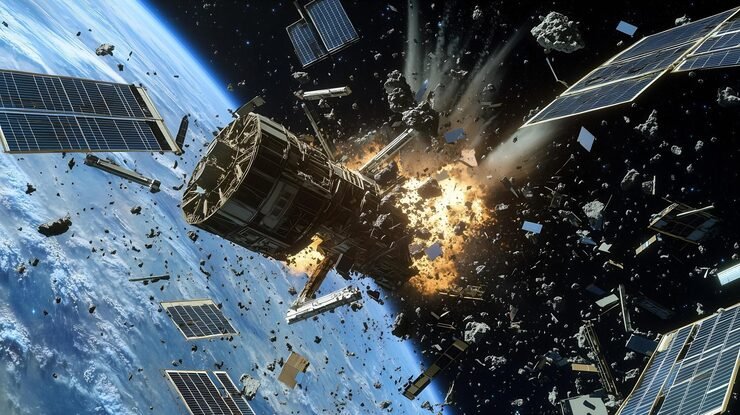

Satellites connect us, but space debris reminds us to protect our skies
The rising number of satellites can carry real risks, depending on how we manage the space around Earth. As of 2025, there are roughly 13,000 active satellites orbiting Earth, and in total, about 15,960–16,000 satellites/objects are catalogued in orbit. At the same time, orbital “traffic” is surging: the growth in satellites over recent years, particularly from large constellations, has crowded popular orbits, especially low‑Earth orbit (LEO).
More than that, they reflect a deeper human ambition. The idea that we could build something outside of Earth’s surface, set it in motion, and have it quietly serve us from above, to communicate, to observe, to unify, feels like poetry in motion. The first satellite, though humble, cast a long shadow: it signified that human curiosity and ingenuity can transcend our earthly constraints.
As orbits get crowded, the chance of collisions rises. When objects collide or old satellites break up, they generate debris, fragments varying from centimetre-sized pieces to larger junk. That debris then itself becomes a hazard, capable of damaging or destroying other satellites.
Many objects (defunct satellites, rocket bodies, fragments) stay in orbit for decades. In some altitudes, there is so much debris that risk becomes persistent and long-term. This doesn’t affect Earth’s environment directly, but it threatens our use of space, communication, navigation, weather monitoring, and scientific observation, things many rely on.
Rocket launches emit pollutants: soot (black carbon), exhaust gases, and chemical byproducts (like alumina, nitrogen oxides, etc.). These reach the stratosphere and mesosphere, where they linger much longer than surface pollution. Studies warn that as satellite‑launch cadence increases, the cumulative emissions, especially from mega‑constellations, could meaningfully affect upper‑atmosphere chemistry: potentially accelerating ozone depletion or changing atmospheric thermal balance.
Satellites are multiplying in the sky like digital constellations, more launches each month, more purposes, more ambition. Yet despite their growing number, they are still tiny compared to Earth’s vast atmosphere and environment. They don’t disturb our weather, oceans, or the air we breathe. Their motion is powered not by engines constantly burning, but by the graceful balance of gravity and their own speed.
Once placed in orbit, they glide like dancers who need only a gentle push to keep circling forever. Over time, most low-orbit satellites naturally fall back toward Earth, pulled down by atmospheric drag; when they re-enter, they usually burn into harmless dust before touching the ground. Only a very small fraction might reach the surface, and the chance of hitting a person is extremely low. The real challenge lies in space itself: debris zipping around like tiny arrows that can damage other satellites we rely on daily. So while they don’t harm Earth’s ecosystem directly, our responsibility is in the heavens, keeping orbits safe, managed, and clean, so our technology above can continue supporting life below.
What Space Debris Is Actually Made Of
Picture everything humans have ever launched that never came back down, that’s basically the whole picture right there. Dead satellites that ran out of fuel or simply stopped functioning. Spent rocket stages, abandoned once they’d delivered their payload. Loose bolts, flecks of paint, even the odd glove lost during old spacewalks decades back.
None of it sounds particularly threatening on its own, until you remember these objects are moving at roughly 28,000 kilometers per hour. At that speed, even something as small as a paint chip carries enough force to punch clean through a satellite’s outer hull. Tracking systems currently catalogue somewhere around 40,000 objects larger than 10 centimeters, and that number doesn’t even include the millions of smaller, effectively untrackable fragments also circling up there right now.
The Kessler Syndrome: When Debris Starts Creating More Debris
There’s an actual name for the worst-case version of this whole problem, and it’s been sitting in the scientific literature longer than most people would guess. Back in 1978, NASA scientist Donald Kessler laid out a scenario where debris density in low Earth orbit gets high enough that collisions alone start producing more debris than natural atmospheric drag can ever clear out.
Cross that tipping point, and the whole thing basically runs on its own, more debris causes more collisions, which creates even more debris, a slow chain reaction that doesn’t need a single additional rocket launch to keep feeding itself. This isn’t some far-off science fiction scenario either. Certain crowded altitude bands are already showing early warning signs of exactly this cascade, which is precisely why space agencies now treat debris mitigation as urgent, not optional.
What’s Actually Being Done to Fix the Problem
Here’s the encouraging part, the space industry isn’t just watching this happen. Newer satellites increasingly come with end-of-life plans built right in, using whatever fuel’s left to guide themselves into a controlled, harmless burn-up rather than drifting around as dead weight for decades afterward.
Regulators have started tightening the rules too, requiring operators to de-orbit defunct satellites within a set number of years instead of just leaving them up there indefinitely. And beyond prevention, active debris removal is finally moving from theory into actual practice, companies like Astroscale have already tested spacecraft built specifically to rendezvous with, capture, and safely de-orbit dead satellites and leftover rocket parts. None of this solves the problem overnight, obviously. But paired with better tracking and genuine international cooperation, it’s a real, encouraging shift, from just watching the problem grow to actually doing something about cleaning it up
It’s Not Simply “More Satellites = Disaster.” Several Factors Temper The Risk:
- Many new satellites are designed to burn up on re‑entry at the end of life, especially those in low orbits, reducing long‑term debris risk.
- Orbits are large and three‑dimensional: many satellites occupy different altitudes, trajectories, and speeds, which reduces the chance of collision compared to if they were all “crammed together.”
- With better tracking, coordination, regulations, and de‑orbiting practices, we can manage space traffic and mitigate debris generation before things spiral. This is absolutely key.
So yes, with growing numbers, risk does scale up. Unless managed, the accumulation of satellites and debris could turn orbits into dangerous zones. In short, yes, increasing satellite launches can be risky. The benefits are immense, but we must be conscious custodians of both space and Earth’s atmosphere if we want that promise to remain sustainable.