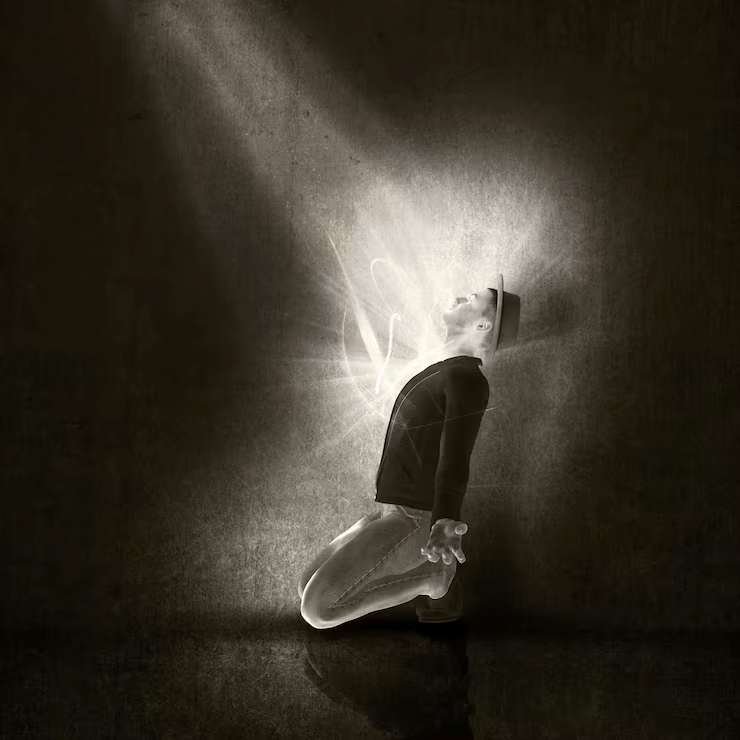

Maybe the body ends, but something within us lives on.
I used to wonder what it is after death? Is there really a soul living inside us? If it is, where does it go after we die? Do Heaven and Hell really exist? What happens to our thoughts, memories, emotions, and the person we were once we are no longer alive?
These questions have made me think many times. I have often found myself thinking deeply about death, life, and what might exist beyond what our eyes can see. And after thinking about it for a long time, I came up with my own theory, not as a proven fact, but as a way of looking at one of life’s greatest mysteries.
Hi, my name is Amarpal Matharu, an enthusiastic writer and a developer by profession. The idea of life after death is something that almost all of us have thought about. Some people think about it out of curiosity, some because of their religious beliefs, and others because they have experienced the loss of someone they deeply loved. The truth is, nobody knows what happens after death.
Different religions and cultures have offered different explanations. The belief is that there is something within us that is more than just our physical body, the soul. Our body is temporary. One day, it grows old, becomes weak, and eventually stops functioning. But many religious and spiritual traditions believe that the soul is different. The body may come to an end, but the soul continues its journey. And this brings us to another question – Where does the soul goes?
According to some religious beliefs, a person who lives a good life and does good deeds may enter Heaven, while someone who commits evil may be sent to Hell. Other traditions believe in rebirth or reincarnation, where the soul leaves one body and begins another life. Some believe that the soul continues its journey through different spiritual realms, while others believe that it eventually becomes one with a greater universal consciousness. There are many beliefs, many theories, and many interpretations. But despite all these explanations, one question continues to remain – What really happens after death?
Perhaps the greatest mystery is that we can ask this question while we are alive, but we cannot return with a definitive answer after we are gone. Maybe death is the end. Maybe it is a beginning. Maybe the soul continues somewhere beyond our understanding. Or perhaps there is a reality that our human minds are simply not capable of seeing or understanding yet.
Science can explain many things about the human body and what happens when life ends. Religion offers spiritual explanations. Philosophy encourages us to question our existence. And the personal experiences of people who have come close to death have given us even more questions to explore. But the final answer remains hidden. And perhaps that is what makes death one of the greatest mysteries of human existence. We spend our entire lives trying to understand the world around us. Yet, when it comes to the one journey that every human being will eventually take, we are still standing at the edge of the unknown, looking into a darkness that no one can fully explain.
So, I began to wonder. What if death is not the end of our story, but simply the beginning of a journey we cannot yet see? This is where my theory begins. The Big Question: What Happens After Death?
The key is to separate what we know, what people report, what science can explain, and what remains a mystery. The honest answer is, we do not know for certain what happens to consciousness after irreversible death. Science can describe what happens to the body when life ends. Our heart stops beating, breathing stops, and eventually brain activity ceases. But the deeper question of whether consciousness itself continues in some form remains unanswered. This is where the subject becomes fascinating.
People who have been close to death and survived sometimes describe experiences that are remarkably vivid. These are generally called Near-Death Experiences (NDEs). Researchers have documented recurring elements such as:
- Feeling separated from the physical body
- Seeing a bright light
- Moving through a tunnel or darkness
- Experiencing an overwhelming sense of peace
- Meeting deceased relatives or other beings
- Feeling surrounded by love
- Reviewing important moments from one’s life
- Experiencing a sense of timelessness
- Feeling that they have entered another reality
- Being told or feeling that they must “return”
- Coming back with a completely different attitude toward life
A person who has a near-death experience has not necessarily experienced irreversible biological death. They have been extremely close to death or experienced a life-threatening condition and subsequently recovered. Therefore, when someone says – “I know what happens after death because I died and came back.” The scientifically accurate response is more nuanced. They may have experienced something extraordinary at the boundary between life and death, but they did not necessarily experience what happens after permanent, irreversible death.
But What Do People Actually Experience?
One of the most interesting areas is the common pattern of NDE(near-death experience) reports. Researchers have identified recurring themes. Bruce Greyson, a major researcher in this field, described experiences involving peace, an altered sense of time, an out-of-body sensation, encounters with a light or other beings, life review, and a sense of reaching a boundary or point of no return. A typical story might sound something like this:
A person experiences cardiac arrest or a severe medical emergency. They lose normal awareness. Then they describe feeling as though they are no longer inside their body. They see their surroundings from somewhere above, move through darkness or a tunnel, encounter an intense light, and feel an overwhelming sense of peace. Some report meeting people they recognize as deceased relatives. Eventually, they return to their bodies. Not everyone experiences all of these elements.
And importantly, not all near-death experiences are positive. Some people report frightening, confusing, or distressing experiences. A recent systematic review found that NDEs can have long-lasting effects, including reduced fear of death and greater appreciation of life, but some experiences can also lead to emotional distress and difficulty integrating what happened.
Another interesting case is that of Dr. Rajiv Parti, a former anesthesiologist, who described a profound NDE during emergency surgery. His account included an out-of-body experience and encounters that he interpreted spiritually. He later described significant changes in his values and outlook on life. His story is a personal account, not scientific proof of an afterlife, but it is an interesting example of how these experiences can transform a person’s worldview
My Theory: The Energy That Remains After Death
As I said in my article, What is After Death. While thinking about it, I developed my own theory, its not a scientific fact, but simply a way of understanding life, death, and the energy we experience around us.
Think about how we feel when we are going through a difficult time. When we are stressed, sad, or under a lot of pressure, everything around us can start to feel negative. Even our surroundings may seem dull or heavy.
But when we are happy, excited, or full of hope, we often feel something completely different. We feel lighter. We feel more energetic. Sometimes, it even feels as though there is a positive energy flowing inside us and around us.
This makes me wonder: Could there really be different kinds of energy surrounding us?
We can see something similar in the people around us. When we spend time with someone who is sad or not happy, we may begin to feel sad ourselves. On the other hand, when we spend time with someone happy and nice, their energy can make us feel better too.
We often say things like, “I can feel the energy in this room,” or “That person has good vibes.” Perhaps there is more to these feelings than we currently understand. This leads me to my theory.
I believe that when a person dies, something connected to that person, what we may call energy, is released from the physical body and becomes part of the environment around us. The physical body comes to an end, but perhaps the energy associated with that person does not simply disappear. Instead, it may return to the larger energy that exists around us. I imagine this energy as having two broad forms: positive and negative.
Perhaps our minds are constantly interacting with these energies. When we think positively, and surround ourselves with positive thoughts and people, we may become more connected to positive energy. When we are constantly surrounded by fear, anger, sadness, or negative thoughts, we may become more connected to negative energy. In this way, I wonder if our thoughts and emotions act like a kind of attraction. Positive thoughts attract positive energy. Negative thoughts attract negative energy.
And perhaps this continues even after death. Maybe the energy of a person does not simply disappear when their life ends. Maybe it becomes part of the world around us, influencing the environment in ways we cannot see or fully understand. And so one possible explanation for why some places feel peaceful, while others feel uncomfortable. It is why we sometimes feel connected to someone even after they are gone. And, in some way, the energy of the people we have loved continues to exist around us.
I do not know if this theory is scientifically correct. I cannot prove it, and I am not presenting it as a fact. It is simply my way of thinking about one of life’s greatest mysteries. Maybe death is not the complete disappearance of a person. Maybe the body disappears, but something remains.
Conclusion
I think it is possible that death is not simply an ending, but a transition into something we cannot currently perceive. What we call the “soul” is something fundamental that we haven’t discovered how to measure. Our consciousness ends when the brain ends. What I find most intriguing is that we don’t even fully understand consciousness while we are alive.
Maybe death is not the end of consciousness, maybe it is the point where our current understanding of consciousness ends.