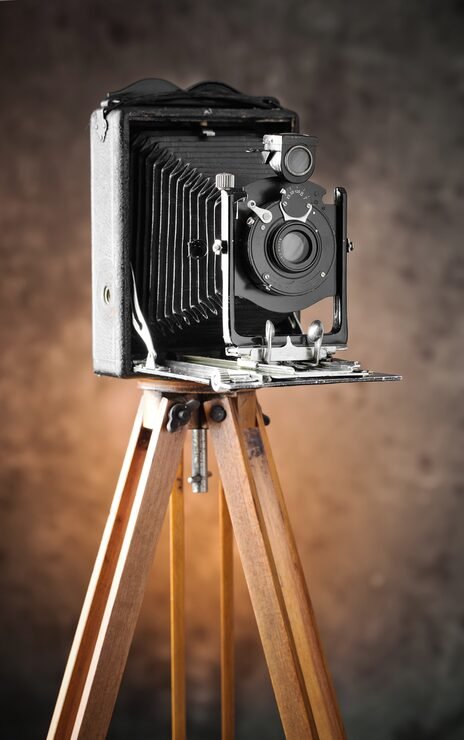

“We think we click pictures. But We’re actually keeping moments alive.”
Have you ever wondered what a camera really captures? Most people would say it captures people, places, or beautiful moments. But I see it differently. I believe a camera doesn’t simply capture people, it captures time. That is what makes it one of the greatest inventions ever created. We often call the mobile phone the greatest invention, and I agree it has changed our lives. But if I had to choose an invention that quietly defeated something humans have never been able to control, I would choose The Camera. Time never stops for anyone. Every second passes, every moment disappears forever. Yet a camera has the incredible ability to preserve one tiny piece of that endless flow.
At first glance, a camera seems simple. We stand still for a moment, someone presses a button, and a picture is taken. It feels like the camera has captured a person. But when I think more deeply, I don’t believe it captures people at all. It captures time. We think it clicks pictures of us, but it captures that particular time, it preserves a moment or freezes our view of a moment
Every photograph is a tiny piece of time that will never exist again. The smile, the sunlight, the clothes we wore, the expressions on our faces, the people standing beside us, everything belongs to a single moment that disappeared the instant the shutter closed. Life kept moving, but that one moment remained frozen forever.
Time is something no human has ever been able to stop. It flows continuously, carrying every second into the past. We cannot hold it in our hands or ask it to wait. Yet the camera does something extraordinary. It gives us a way to preserve a single instant, almost as if it gently tells time, “Stay here for a while.” That is what makes the invention so beautiful.
Early cameras could not even capture colors. Their photographs were only black and white. Yet those pictures still carry enormous emotional value. They prove that colors are not what make memories meaningful. The people, the emotions, and the story inside the frame are what truly matter.
I never met my grandfather because he passed away before I was born. In reality, I have never heard his voice or shaken his hand. But I know his face because my father has his photograph. Without that camera, my grandfather’s appearance would have lived only in someone’s memory. Thanks to a single photograph, his presence reaches across generations. A machine allowed someone I never met to become familiar to me. That is one of the camera’s quiet miracles. It connects people who never lived in the same moment. A grandchild can see a grandparent. Future generations can see us long after we are gone. A photograph becomes a conversation between different times.
Photographs never move. They never speak. They remain perfectly still. Yet when we look at them, our minds begin to move. We imagine the laughter that happened just before the picture was taken. We wonder what people were thinking. We remember voices, places, smells, and emotions. A silent image awakens an entire world inside us.
Perhaps that is why old photographs feel so powerful. They remind us that everything changes. Children become adults. Parents grow older. Friends move away. Some people leave this world. Buildings disappear. Seasons pass. But one tiny square of paper or one digital image continues to whisper, “This moment was real.”
In that sense, a camera is more than a machine with a lens. It is a keeper of memories, a witness to history, and a collector of moments that time itself refuses to return. We often think we are taking pictures, but perhaps the truth is that we are preserving pieces of our lives before they quietly become the past.
How The Camera Was Born: A Brief History
The history of the camera is much older than most people think. The idea of a camera existed long before photography was invented. Around the 5th century BCE, the Chinese philosopher Mozi and later the Greek philosopher Aristotle described a simple optical principle that would eventually become the foundation of all cameras. This device was called the camera obscura, a Latin term meaning “dark chamber.” It was simply a dark room or a sealed box with a tiny hole on one side. Light entered through the hole and projected an upside-down image of the outside world onto the opposite wall. However, this image could only be viewed, it could not be recorded or preserved. Artists often used camera obscuras to trace landscapes and buildings accurately centuries before photography existed.
The real breakthrough came in France during the early 19th century. That change came around 1826, when a French inventor named Joseph Nicéphore Niépce created what’s considered the world’s first permanent photograph. He called it “View from the Window at Le Gras,” and it simply showed the view from his own house. Getting that one image took several hours of sunlight, since the materials back then just weren’t very light-sensitive.
Early cameras were bulky wooden boxes sitting on tripods. No film, no digital sensors — just metal or glass plates coated in light-sensitive chemicals. And because exposures took so long, anyone being photographed had to stay completely still, sometimes for minutes at a stretch.
Niépce coated a polished pewter plate with a thin layer of bitumen of Judea, a natural asphalt that hardens when exposed to sunlight. He placed the plate inside a camera obscura and pointed it out of his window. Because the material was not very sensitive to light, the exposure took many hours, traditionally estimated at around eight hours, although some historians believe it may have taken several days
Although Niépce made history, In 1829, he partnered with another French inventor, Louis Daguerre, to improve the technology. After Niépce died in 1833, Daguerre continued the research and introduced the daguerreotype process in 1839. Instead of bitumen, Daguerre used a silver-plated copper sheet coated with iodine, making it much more sensitive to light.
Here’s the thing, though the core idea behind a camera hasn’t really changed since then. Light comes in through the lens, gets focused onto a light-sensitive surface, and that’s it. Old cameras used chemical-coated plates or film for that surface. Today’s cameras and smartphones use a digital sensor instead CMOS or CCD which turns light into electrical signals and builds the image from there.
The Present: Where the Camera Stands Today
Cameras today have moved far beyond just taking pictures. They’re everywhere, often working quietly in the background without us even noticing. Security cameras watch over streets, offices, and homes, some smart enough to recognize faces or send an alert the moment something looks off. Cars now come packed with cameras too reversing cameras, lane-assist systems, even dashcams that record every drive, quietly becoming a second pair of eyes for the driver. Filmmaking has changed just as much. What once needed heavy, expensive equipment can now be shot on a phone that fits in your pocket, with editing tools that used to require entire studios.
And then there’s the most familiar use of all the everyday photo. A quick selfie, a candid shot of friends, a plate of food before anyone eats it. Smartphone cameras have basically replaced the need to carry a separate camera around, using AI to sharpen images, adjust lighting, and blur backgrounds automatically, no technical know-how required. From keeping a building safe to helping a car avoid an accident to just capturing a random Tuesday afternoon, the camera has quietly become one of those tools we don’t think twice about until, of course, it’s not there.
Conclusion
A camera is such a small, ordinary object, and yet it does something no human ever could it holds onto time, even for just a moment. From a dark box with a tiny hole to the phone sitting in your pocket right now, the tools have changed completely, but the purpose never did. It was never really about the picture. It was always about the moment behind it, the one that would’ve disappeared the second it happened, if something hadn’t quietly stepped in and said, stay. That’s the real magic of the camera. Not the lens, not the sensor, not the technology at all. Just its quiet refusal to let time win completely.