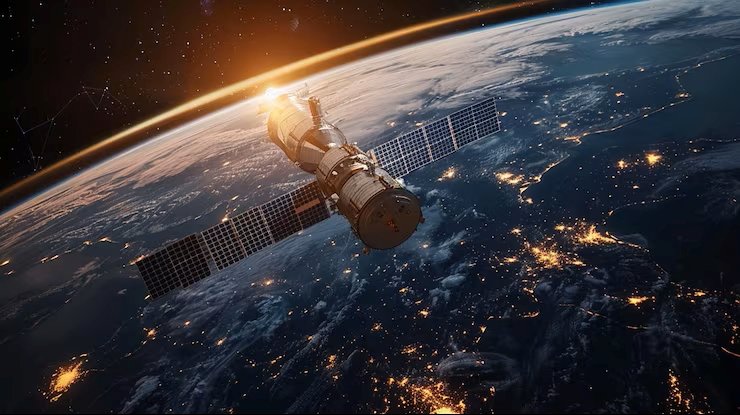

Satellites connect our world, expanding knowledge, bridging distances, and empowering global innovation every day.
Satellites are like tireless envoys of the Earth, launched into the sky with enough forward momentum that they keep falling, but never quite reach the ground. Gravity becomes their dance partner, constantly pulling them inward, while their motion pushes them ahead, creating a perfect balance of eternal motion around the planet. In this celestial conference room, each satellite occupies a strategic position, synchronized with Earth’s rotation or sweeping rapidly across the globe, quietly routing data, guiding navigation, forecasting weather, and connecting humanity’s ambitions across continents. They don’t simply “hang” in space, they sprint along invisible highways, powered by physics and purpose, transforming the quiet emptiness above into a thriving network that empowers our modern world.
Satellites guide the traveler who trusts their map, carry the whispers of phone calls across oceans, and help farmers know when the rains will bless their fields. They watch storms swirl so we can prepare, and observe continents slowly shifting so scientists can understand the planet’s heartbeat. They beam television into our living rooms and the internet into remote villages where wires dare not reach. Even national security agencies gaze through their electronic eyes, defense forces treat satellites like strategic guardians in the sky. They extend awareness far beyond human sight, quietly surveying borders, tracking movement, and ensuring communication flows even when the ground trembles with uncertainty.
In simple essence, satellites provide us with a higher perspective on the Earth’s problems, transforming distance into closeness, uncertainty into insight, and our collective progress into a constellation of possibilities. There are indeed many different types of satellites, each built and sent up with a specific purpose in mind. Even the increasing number of satellites in Earth’s orbit has raised the risk of space debris, which can be harmful to both humans and the environment.
The Physics: How Satellites Stay in Orbit
At its core, a satellite’s existence hinges on a delicate balance between gravity and motion. Here’s how:
- When a satellite is launched, it is given a horizontal velocity (i.e., sideways speed) large enough that while gravity keeps pulling it toward Earth, its forward movement means it constantly “falls around” the planet rather than straight back down. In effect, the satellite is in a perpetual free-fall, but because of its sideways speed, the Earth curves away beneath it at the same rate.
- This balance means the satellite doesn’t crash or drift off to space; instead, it traces a stable orbit. The shape of the orbit can be circular or elliptical, depending on initial speed and direction.
- Over long timescales, a satellite’s orbit can be affected by small perturbations, for example, gravitational influences from the Earth’s asymmetric shape (the Earth isn’t a perfect sphere), the Sun, the Moon, and other factors. But many orbits are chosen carefully to remain stable for years.
- For communication, weather, observation, or GPS-type tasks, satellites carry instruments, radio transmitters, sensors, cameras, and transmit data back to Earth, or relay signals across vast distances. Their high altitude and unobstructed vantage point make them perfect for seeing the big picture (storms, terrain, global communications, etc.).
In simpler terms: a satellite is constantly falling toward Earth, but also constantly missing it, because it’s racing sideways so fast that Earth’s surface curves away underneath. That dance between gravity and speed is what keeps it “hanging” up there.
Who First Dreamed It : From Idea to Reality
The concept of artificial satellites, objects orbiting Earth that humans control, emerged as visionaries and scientists considered using Earth’s skies as a global stage for communication and observation. One influential thinker was Arthur C. Clarke. In 1945, he famously proposed that “rocket stations”, what we’d call satellites, could be placed in high orbit to relay radio and television signals globally. That idea, once speculative and literary, laid part of the conceptual groundwork for real satellites decades later
But concept alone wasn’t enough: it demanded breakthroughs in rocketry, engineering, and orbital physics. The real-world push came during the Cold War era, when global powers raced to demonstrate technical and strategic supremacy.
First Satellite: When and Where : Historic Moment
The world’s first artificial satellite was Sputnik 1, launched by the Soviet Union on October 4, 1957.
- Sputnik 1 was roughly the size of a beach ball (about 58 cm in diameter) and weighed around 83.6 kg.
- It was launched from what is now known as the Baikonur Cosmodrome (in present-day Kazakhstan), using a rocket to provide it with the necessary speed and altitude for orbit.
- Once in orbit, Sputnik 1 circled the Earth approximately every 96–98 minutes.
- Although it carried only a basic radio transmitter, the mere fact that humanity had placed an object into persistent orbit was revolutionary, it opened the door to everything from weather satellites to global communications, Earth observation to GPS.
Thus did humanity step into the “space age”, with a small metal sphere, four antennas, and a dream.