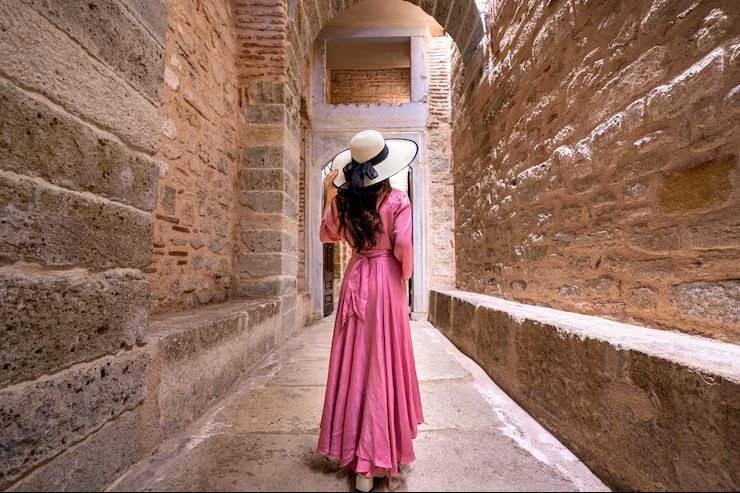

Where stone remembers kings, and time still bows to tradition.
There’s a particular kind of quiet that settles over you the moment you walk through the gates of a Rajasthan fort for the first time. It’s not silence exactly, there are usually vendors calling out, guides narrating, other travelers snapping photos, but underneath all that noise, there’s this strange stillness, like the walls themselves are still holding onto something from centuries ago.
Rajasthan has a way of doing that to first-time visitors. You come expecting forts and palaces, maybe a camel ride, some good photos for the feed. You leave having accidentally fallen into something closer to a history lesson that actually stuck, wrapped in golden sandstone, painted havelis, and sunsets that genuinely don’t look real in photos. If you’re planning your first heritage trip through Rajasthan, here’s an honest, unhurried guide to where that journey should actually take you.
Amber Fort, Jaipur
Most heritage trails through Rajasthan start in Jaipur, and Amber Fort is usually the first real gut-punch of scale and beauty. Perched on a hill overlooking Maota Lake, the fort blends Rajput and Mughal architecture in a way that feels less like a building and more like an entire small city carved into the hillside.
What catches most first-timers off guard isn’t the size of the fort, it’s the detail. The Sheesh Mahal, the mirror palace inside, is lit by a single candle during evening tours, and the way that one flame multiplies across thousands of tiny mirrored fragments is something photos genuinely fail to capture. You have to stand there to actually get it.
Arriving early morning, before the tour groups build up, makes a real difference here. The light is softer, the courtyards are quieter, and you get a few genuinely peaceful minutes inside a place that gets loud by mid-morning.
City Palace and Hawa Mahal, Jaipur
Jaipur’s City Palace still functions partly as a royal residence, which gives it a very different energy from a fort that’s purely a monument. Walking through its courtyards, you’re not just looking at history, you’re walking through a space that’s still, in some quiet way, being lived in.
A short walk away sits Hawa Mahal, the Palace of Winds, probably one of the most photographed facades in the country. What most first-time visitors don’t realize until they’re standing in front of it is that the pink sandstone structure was built with 953 small windows specifically so royal women could observe street life below without being seen themselves. It’s a small detail that changes how you look at the entire building.
- Best photographed in early morning light, when the pink sandstone glows warmest
- City Palace museum houses royal costumes, weapons, and manuscripts
- Hawa Mahal is best viewed from the street directly opposite, not just from inside
Mehrangarh Fort, Jodhpur
If Amber Fort is elegant, Mehrangarh is imposing. Sitting nearly 400 feet above Jodhpur’s blue-washed old city, this fort feels like it was built to intimidate first and impress second, and honestly, it still does both remarkably well.
The audio guide here is genuinely worth the extra cost, since it walks you through stories most visitors would otherwise completely miss, handprints of royal wives on the fort’s walls, cannonball scars from old battles, and the sheer engineering effort it took to build something this massive on solid rock centuries ago.
From the fort’s ramparts, the view down onto Jodhpur’s famous blue city is the kind of moment that makes an entire trip feel worth it. Rows of indigo-washed houses stretching out below, with the desert beginning somewhere just past the horizon.
Jodhpur itself, often called the Blue City, is worth wandering through slowly, not just rushing between two monuments. Its old market lanes, tucked beneath the fort’s shadow, are where a lot of the city’s real character actually lives.
Jaisalmer Fort and the Golden City
Unlike most forts in Rajasthan that have been emptied out into pure museums, Jaisalmer Fort is a living fort, with families, shops, and homes still functioning inside its walls today. Walking through it doesn’t feel like touring a monument. It feels like wandering through an actual living neighborhood that happens to be built from centuries-old golden sandstone.
The fort glows a deep amber-gold at sunset, which is exactly where its nickname, the Golden City, comes from. First-time visitors should plan to be somewhere with a clear view of the fort right around sunset, whether that’s a rooftop restaurant or one of the nearby sand dunes, because the color shift is genuinely dramatic.
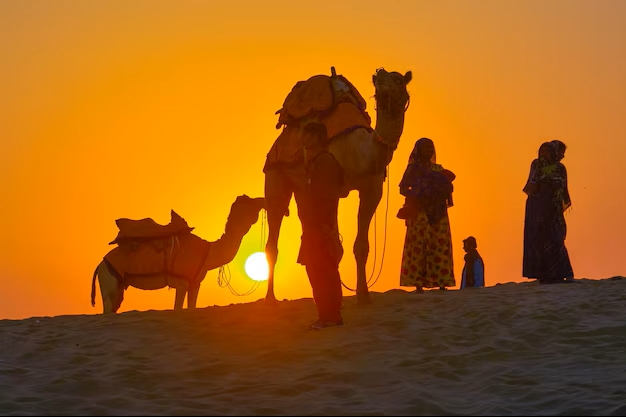
Just outside the city, the Sam Sand Dunes offer the classic Rajasthan desert experience most travelers picture before they even arrive, camel rides at sunset, folk music around a fire, and a night sky that city dwellers rarely get to see this clearly.
City Palace and Lake Pichola, Udaipur
Udaipur softens the trip in the best possible way after the desert heat of Jaisalmer and Jodhpur. Often called the City of Lakes, it trades imposing hilltop forts for elegant palaces reflected in still water, and the change of pace tends to be exactly what a first-time traveler needs by this point in the journey.
The City Palace here is Rajasthan’s largest, a sprawling complex of courtyards, museums, and balconies overlooking Lake Pichola. A boat ride across the lake at sunset, with the palace lights slowly coming on along the water’s edge, is one of those experiences that quietly becomes everyone’s favorite memory from the whole trip, even if they didn’t expect it going in.
Chittorgarh Fort
Less crowded than the other major forts, Chittorgarh carries a heavier, more emotional history, one tied closely to stories of Rajput valor and sacrifice that are still spoken about with real reverence across Rajasthan today. It’s the largest fort complex in India, and walking its grounds takes genuine time, so it’s worth planning a half day here rather than rushing through.
For travelers who want their heritage trip to feel less curated for tourists and a bit more raw and historically grounded, Chittorgarh usually ends up being the most memorable stop of the entire journey.
Practical Tips for First-Time Heritage Travelers
Rajasthan’s heat can be intense for much of the year, so planning visits between October and March makes the experience considerably more comfortable, especially since most forts involve a fair amount of walking under open sky.
Hiring a local guide at each major site, rather than relying only on signage, genuinely changes how much of the history actually sticks with you afterward. A lot of what makes these forts fascinating isn’t visible at all unless someone explains it.
- Visit between October and March for cooler, more comfortable weather
- Wear comfortable footwear, since most forts involve significant walking
- Book heritage hotel stays where possible, many are converted havelis and palaces
- Carry cash for smaller local vendors and rural areas
Rajasthan doesn’t just show you its history, it hands it to you slowly, fort by fort, sunset by sunset, until you realize somewhere around day four or five that you’re not just sightseeing anymore. You’re actually absorbing it. For a first-time traveler, that’s really the whole point of a heritage tour done right, not just checking off monuments, but leaving with a genuine, felt sense of a place that’s been standing long before you arrived, and will keep standing long after you’ve gone home.