
Sri Hemkund Sahib: A Sacred Journey in the Himalayas
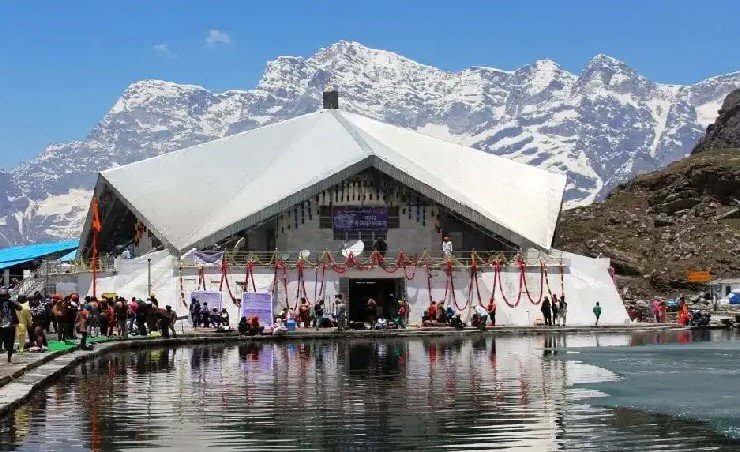
In The Northern Part of India, high in the Himalayas of Uttarakhand, surrounded by snow-covered mountains and calm natural landscapes, lies Sri Hemkund Sahib, one of the most respectable Sikh pilgrimage sites in India. Located at an altitude of about 4,329 metres (14,200 feet) above sea level, this sacred place is built beside the beautiful Hemkund, a glacial lake whose waters remain cold throughout much of the year. The journey to Hemkund Sahib is not only a religious pilgrimage but also a physically demanding mountain trek that brings visitors close to nature.
Sri Hemkund Sahib holds a special place in Sikh history and is closely associated with the tenth Sikh Guru, Guru Gobind Singh Ji. According to Sikh tradition, the Guru meditated at this location in a previous spiritual existence. The site became widely known after the place was identified and developed as a pilgrimage destination in the 20th century. Today, thousands of devotees travel here every year to offer prayers, experience the peaceful surroundings and understand the spiritual significance of the place.
The journey to Hemkund Sahib usually begins from Govindghat, followed by a road journey to Pulna and then a challenging trek to Ghangaria before reaching Hemkund Sahib. The route passes through the remarkable Himalayan landscape and the Valley of Flowers region.
For many visitors, Hemkund Sahib is more than a destination on a map. It is a journey of faith, endurance and reflection, where the silence of the mountains becomes an important part of the experience.
The Discovery Story
For generations, the story of Hemkunt lived only in Sikh religious writing. Old texts described a high mountain ringed by seven peaks, a place where Guru Gobind Singh Ji had meditated before coming into this world. But nobody could point to it on a map. In the 1800s, scholars like Pandit Tara Singh Narotam wrote about Hemkunt, keeping the old description from fading away. Later on, Bhai Vir Singh went through these references himself and wrote about the place too, and his work is really what pushed people to start looking for it seriously.
Then, in the early 1930s, a retired Sikh religious teacher named Sant Sohan Singh, who’d also served in the British Indian Army, got fixed on the idea of finding this place. In 1933 he headed into the rough terrain of what’s now Chamoli district in Uttarakhand. Up there, he came across a remote lake, called Lokpal by locals, sitting high among seven mountain peaks. The scene lined up with enough of the old descriptions that he was convinced this was Hemkunt. He teamed up with Bhai Vir Singh and Havaldar Modan Singh afterward, and together they set about turning the site into a proper place of Sikh worship.
A small structure for prayer went up at the lake in 1935, and the Guru Granth Sahib was brought there soon after. None of this was easy. There were no roads back then, no trekking paths worth the name, just difficult ground and worse weather. Slowly, over the decades that followed, both the shrine and the route leading to it were built up bit by bit. A remote lake in the Himalayas turned, over time, into Sri Hemkund Sahib, now one of the most visited Sikh pilgrimage sites in the world, drawing people from India and well beyond.
Location and How to Get There
Chamoli district, Uttarakhand. Garhwal Himalayas. That’s where Sri Hemkund Sahib sits, right next to Hemkund Lake, a glacial lake with seven mountain peaks standing guard around it. Altitude-wise, we’re talking about 4,329 metres, roughly 14,200 feet. High enough that it’s usually called the highest Sikh pilgrimage site anywhere. And the weather knows it. Even during the season when things are supposedly “open,” mornings near that lake can bite. Snow buries the whole area for a good chunk of the year too, so there’s really only a small window when the shrine is even reachable.
Most trips begin at Govindghat. That’s as far as a road takes you. After that, you’re walking, starting from Pulna, where the actual trek kicks in. Next stop, Ghangaria, a tiny mountain settlement that basically every pilgrim and trekker passes through. Pulna to Ghangaria runs about 13 km, cutting along the Pushpawati and Lakshman Ganga valleys. Fair warning, it’s not flat. Ghangaria also happens to be the jumping-off point for the Valley of Flowers, so a lot of people knock out both in one trip.
From Ghangaria, there’s still 6 km left, and this is the part that actually hurts. Altitude climbs fast here, steep the whole way. Some sections allow ponies or palkis depending on the season, but plenty of people just walk it. Thin air, cold, steep ground, not exactly a stroll. Go slow. Take breaks. Nobody’s timing you.
When Can You Actually Visit
Not year-round, that’s for sure. Winter buries the route in snow, so no one is allowed to go there for months. Season usually kicks off around May or June, depending on how that year’s weather behaves, and runs till October before winter comes back for it. Dates move a little each year, so check before you book anything solid.
What to Pack
This isn’t a weekend picnic. High altitude changes what you need:
- Warm stuff, jacket, sweater, thermals, gloves, wool socks
- Waterproof jacket, mountain weather flips fast
- Trekking shoes with actual grip, not sneakers
- Water bottle, but don’t overpack it
- Your regular meds plus a small first-aid kit
- Sunglasses, sunscreen, a cap, sun hits harder up there than you’d think
- ID, keep it on you
- Small backpack, less weight, easier climb
One more thing worth saying plainly: altitude sickness is real. Bad headache, trouble breathing, dizziness, feeling off, real weakness, none of that should be pushed through. Stop. Tell someone. Get help if it’s needed. Faith gets people up that mountain, but respect for the terrain is what gets them back down safely.
Religious and Historical Significance
Guru Gobind Singh Ji, the tenth Sikh Guru, is at the heart of why this place matters. Sikh tradition talks about a spot called Tap Asthan Hemkunt, where he meditated before he was even born into this life. Seven peaks around a mountain, that’s the description. When this location got identified, the match was close enough that people took it as confirmation. For Sikhs, that’s what gives the place its weight. It’s not just somewhere to pray. It stands for meditation, courage, faith, all of it wrapped into one spot.
The gurdwara by the lake is the centre of it all. Every year, pilgrims push through the mountains to reach it, and honestly, a lot of them say the trek itself is part of the point. It takes effort, patience, some grit. And the setting, quiet lake, tall peaks, none of that noise, makes it feel nothing like visiting a shrine in a city.
There’s a Hindu side to this too. The area ties into the Lokpal tradition, and Hindu pilgrims have long treated this stretch of Himalaya as sacred ground. The Lakshman Temple nearby, linked to Lakshman in local tradition, adds another reason people come. Two faiths, same mountains. Not something you see everywhere.
At the end of the day, Hemkund Sahib isn’t just a high shrine or a pretty lake. For Sikhs, it’s tied to the spiritual story of Guru Gobind Singh Ji. For Hindus, the area carries its own weight. And for everyone else, it’s a shot at real quiet, real scale, up in the mountains. Faith, history, nature, sheer physical effort, that mix is what makes the place stand out.